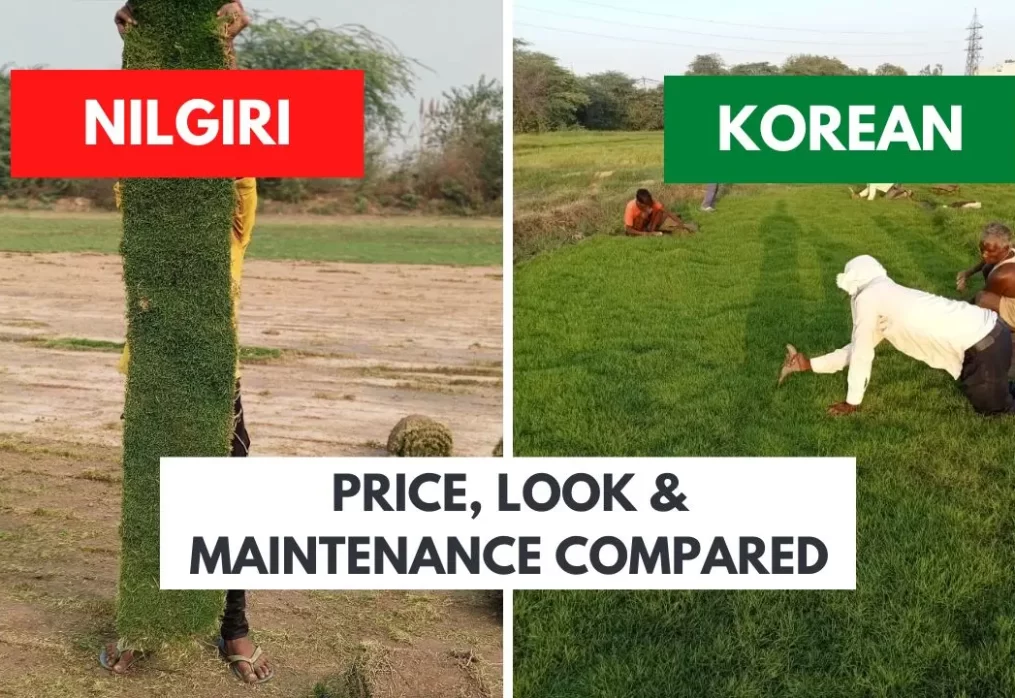
 by Balaji Nursery Editorial Team
Nilgiri Grass vs Korean Grass – Price, Look & Maintenance Compared
Nilgiri Grass is affordable (₹5–₹8/sq ft), fast-growing, low-maintenance, and handles heavy foot traffic — ideal for budget-friendly home lawns, parks, and farmhouses in North India. Korean Grass (Zoysia Matrella) is a premium ornamental variety (₹15–₹25/sq ft) with a soft, carpet-like texture suited for luxury residential and hotel gardens, but requires more water, care, and cost. Choose Nilgiri for durability and savings; choose Korean Grass for a premium, golf-course finish. Balaji Nursery supplies both grass varieties across India — call 8766234417 for pricing and availability.
Introduction to the Comparison
Choosing between Nilgiri and Korean grass is one of the most common dilemmas for homeowners in India, especially in Delhi, Chandigarh, Punjab, Haryana, and other North Indian climates. Both grasses look beautiful, but their price, maintenance, and long-term performance vary significantly.
So, which one is better for your garden?
Let’s compare them in-depth.
What Is Nilgiri Grass?
Nilgiri Grass is a hardy, fast-growing, natural lawn grass variety commonly used across India. It is known for:
Medium-green colour
Long leaves
Affordable price
High adaptability
Botanical Features
Nilgiri Grass has slightly broad blades and grows aggressively, making it good for quick lawn coverage.
Climate Suitability
Thrives in hot and dry climates
Ideal for North Indian summers
Can tolerate moderate cold
Common Uses
Farmhouses
Public parks
School and college lawns
Budget-friendly home lawns
What Is Korean Grass?
Korean Grass (Zoysia Matrella) is a premium ornamental grass known for its soft texture and luxurious carpet-like appearance.
Botanical Features
Very fine leaves
Dense growth pattern
Slow-growing
Climate Suitability
Prefers humid to semi-humid climates
Performs well in moderate temperatures
Tolerates sunlight but not harsh extremes
Common Uses
Premium residential lawns
Hotel gardens
Corporate lawns
Home gardens requiring a “luxury look”
Every lawn behaves differently depending on grass type, usage, and season. Instead of guesswork, you can get a personalized grass care plan using our smart tool designed for Indian conditions.
Nilgiri Grass vs Korean Grass – Price Comparison
Price per Square Foot in Delhi
| Grass Type | Price per Sq Ft (Delhi NCR) |
|---|---|
| Nilgiri Grass | ₹5 – ₹8 per sq ft |
| Korean Grass | ₹15 – ₹25 per sq ft |
Korean Grass can cost 3–4 times more than Nilgiri Grass.
Price in Other Cities
Chandigarh: ₹6–₹8 (Nilgiri), ₹18–₹25 (Korean)
Jaipur: ₹5–₹7 (Nilgiri), ₹15–₹20 (Korean)
Lucknow: ₹6–₹8 (Nilgiri), ₹15–₹22 (Korean)
Why Is Korean Grass Costlier?
Slow growth (takes longer to produce)
High transportation & labour cost
Premium ornamental look
Needs careful installation
Appearance & Texture Comparison
Nilgiri Grass Look
Medium green
Long, thin blades
Slightly rough texture
Looks natural and vibrant
Korean Grass Look
Very fine texture
Carpet-like density
Soft and lush
Appears more “luxury” and uniform
Which Looks More Premium?
Korean Grass wins — it gives a golf-course type finish.
Growth Speed & Spreading Pattern
Nilgiri Grass Growth
Fast-growing
Covers empty patches quickly
Needs frequent trimming
Korean Grass Growth
Very slow growth
Takes time to spread
Requires precision care
Winner: Nilgiri for Speed
If you want a lawn to cover fast, Nilgiri Grass is better.
Watering Needs Comparison
Nilgiri Grass Water Requirement
Medium water requirement
Can survive mild drought
Suitable for Indian summers
Korean Grass Water Requirement
Requires consistent moisture
Cannot tolerate long dry spells
More water-dependent than Nilgiri
Which Saves More Water?
Nilgiri Grass uses significantly less water.
Maintenance Comparison
Mowing Frequency
Nilgiri: Weekly trimming
Korean: Twice a month
Fertilizer Needs
Nilgiri: Moderate
Korean: Requires high-quality fertilizers regularly
Pest & Disease Tolerance
Nilgiri: Highly resistant
Korean: Sensitive to fungal issues
Weed Resistance
Nilgiri: Medium
Korean: Very high (due to density)
Durability & Foot Traffic Handling
Nilgiri Grass
Handles heavy footfall well
Great for kids, pets, events
Korean Grass
Does not tolerate heavy foot traffic
Ideal for decorative areas only
Winner: Nilgiri Grass for durability.
Seasonal Performance
Nilgiri Grass
Stays green in summers
Slightly dull in extreme winters
Recovers fast
Korean Grass
Stays green in moderate temperatures
Turns brown in very cold winters
Slow recovery
Installation & Lawn Preparation
Soil Requirement
Nilgiri: Grows in most soils
Korean: Needs soft, fertile, well-drained soil
Slope & Drainage
Nilgiri: Works everywhere
Korean: Needs proper slope to avoid waterlogging
Rooting Time
Nilgiri: 7–15 days
Korean: 20–30 days
Pros & Cons of Each Grass
Nilgiri Grass Pros
Affordable
Fast-growing
Good for heavy use
Low maintenance
Nilgiri Grass Cons
Slightly rough texture
Not as premium-looking
Korean Grass Pros
Very soft
Extremely premium look
Dense & carpet-like
Great weed resistance
Korean Grass Cons
High price
Slow growth
Not suitable for rough use
Needs high care
Which Grass Should You Choose? (Expert Verdict)
Best for Budget Buyers – Nilgiri Grass
If you want a good-looking lawn at an affordable price with low maintenance, choose Nilgiri Grass.
Best for Premium Lawns – Korean Grass
If your focus is appearance and you don’t mind investing time & money, Korean Grass is unbeatable.
Best for Low Maintenance – Nilgiri Grass
It requires less care, less cost, and less watering.
Conclusion
Nilgiri and Korean Grass each have their unique strengths. Nilgiri is perfect for practical, durable, and budget-friendly lawns, while Korean Grass is ideal when you want a premium, lush, ornamental lawn. Your choice depends on your budget, maintenance ability, and how you plan to use your lawn.
FAQs
1. Which grass is best for Delhi weather?
Nilgiri Grass performs better due to heat tolerance.
2. Does Korean Grass require more water?
Yes, it needs consistent moisture.
3. Which grass looks more premium?
Korean Grass has a finer, carpet-like texture.
4. What is the price difference between the two?
Korean is 3–4 times costlier than Nilgiri.
5. Which grass is better for kids and pets?
Nilgiri Grass handles more foot traffic.
Last Updated on 4 months ago by Balaji Nursery Editorial Team

- How does vetiver protect roads, rivers and hillsides? - September 19, 2026
- Should you grow your lawn from seed or lay sod rolls? - September 11, 2026
- How do you grow a lawn from seeds if you have never done it before? - September 7, 2026