 by Balaji Nursery Editorial Team
Why does soil treatment before laying grass decide whether your lawn survives or fails?
The grass is perfect. The turf rolls are fresh. The gardener lays them neatly. Two months later, patches turn brown. Water pools in corners. The edges lift. Weeds take over.
What went wrong? Not the grass. The soil underneath.
Soil treatment is the step that separates a lawn that thrives for years from one that starts dying in its first season. It’s also the step that 80% of homeowners skip because nobody told them it mattered.
This guide covers everything that should happen to your soil before a single blade of grass touches it. Testing, fixing, grading, amending and preparing. Do this right and your lawn practically runs itself. Skip it and you’ll spend years and money trying to fix problems that should never have existed.
What actually goes wrong when you skip soil treatment?
Most new lawns in India are laid on whatever soil the builder left behind. And builder soil is the worst possible base for grass.
Construction debris mixed in. Cement chunks, brick pieces, plaster, wire, plastic — all buried under a thin layer of topsoil. Grass roots hit these obstructions and stop growing. You see perfect patches next to dead patches with no explanation. The explanation is 6 inches under the surface.
Compacted subsoil. Heavy machinery during construction compresses the soil into a hard pan. Water can’t penetrate. Roots can’t push through. The grass sits on top of what’s essentially a clay slab. Every monsoon, water pools. Every summer, the grass dies because the roots never went deep enough.
Wrong pH. Builder soil often has cement and lime residue that pushes pH above 8 (alkaline). Most lawn grasses prefer 6 to 7 (slightly acidic to neutral). In alkaline soil, iron and manganese become unavailable to the grass even if they’re present. The lawn turns yellow and no amount of fertilizer fixes it because the problem is chemistry, not nutrition.
Zero organic matter. Construction site soil has been stripped, moved, dumped and compressed. The living topsoil layer with its microbes, earthworms and organic matter is gone. What’s left is mineral dead soil that can’t support a healthy lawn without serious amendment.
Drainage disasters. Without proper grading, some areas collect water and others stay dry. Low spots become swamps in monsoon. High spots bake in summer. The grass responds accordingly — lush in some places, dead in others.
How do you test your soil before starting?
You don’t need a lab for everything. Some tests you can do yourself in 10 minutes.
The dig test: Dig 30 cm down in 3 to 4 spots across your lawn area. Look at what’s in there. If you hit rubble, stones or hard pan within the first 20 cm, those obstructions need to come out before anything else.
The squeeze test: Take a handful of moist soil and squeeze it. If it forms a hard ball that doesn’t crumble, it’s heavy clay. If it falls apart immediately and won’t hold shape at all, it’s sandy. If it forms a ball that crumbles when you poke it, it’s loam. This tells you which amendments you need.
The water test: Dig a hole 30 cm deep and 30 cm wide. Fill it with water. Let it drain completely. Fill it again and time how long the second fill takes to drain. Under 1 hour is sandy (drains too fast). 1 to 4 hours is ideal. Over 4 hours means poor drainage (probably clay or compaction).
Lab test (recommended): For Rs 200 to Rs 500, any agricultural university or soil testing lab will give you pH, NPK levels, organic carbon percentage, electrical conductivity (salinity) and texture classification. This takes the guesswork out. Most state agricultural universities have soil testing labs that accept walk in samples.
Understanding which soil type works best for grass helps you interpret these results and decide what needs fixing.
How do you fix common soil problems before laying grass?
Each soil problem has a specific fix. Throwing generic manure at every problem doesn’t work.
Heavy clay soil: Mix coarse river sand and FYM into the top 15 to 20 cm. Use a ratio of 30% sand, 30% FYM and 40% existing soil. The sand opens drainage channels. The FYM adds organic matter that prevents the clay from re-compacting. For a 1,000 sq ft area at 15 cm depth, you need roughly 4 to 5 tonnes of sand and 2 to 3 tonnes of FYM. It sounds like a lot, but this is a one time fix that lasts the life of the lawn.
Sandy soil: Mix FYM and vermicompost into the top 15 cm. Use 4 to 5 kg per sq metre of FYM to add bulk organic matter that holds water. The organic particles act like sponges between the sand grains. Add a layer of red soil or clay loam at the bottom (10 cm depth) if possible. This creates a moisture barrier that slows drainage enough for roots to drink.
Alkaline soil (pH above 7.5): Add sulphur or gypsum to bring the pH down. Agricultural sulphur at 50 grams per sq metre, mixed into the top 10 cm, drops pH by about 0.5 to 1 point over 2 to 3 months. Vermicompost also helps because its organic acids gradually lower pH. For severely alkaline soil (pH 8.5+), you may need professional guidance.
Acidic soil (pH below 5.5): Add agricultural lime (calcium carbonate) at 100 to 200 grams per sq metre. Mix into the top 10 cm and water well. Test again after 4 to 6 weeks. Red and laterite soils in Karnataka, Kerala and parts of the Northeast are naturally acidic and usually need liming before any grass will grow well.
Saline soil (high EC): Flush with heavy watering to leach salts downward. Improve drainage first (add sand, install a subsurface drain if needed). Add gypsum at 200 to 500 grams per sq metre to displace sodium from the soil particles. This is common in parts of Rajasthan, Gujarat and coastal areas. Saline soil is the hardest to fix and may need multiple rounds of treatment.
Compacted soil (hard pan): Break the hard layer mechanically. Rotavate or deep plough the top 20 to 25 cm. If the hard pan is deeper than 25 cm, use a subsoiler or JCB to crack it. After breaking compaction, mix in FYM and sand to prevent it from re-forming. Adding organic matter is the only long term solution to compaction.
What does proper soil grading and levelling look like?
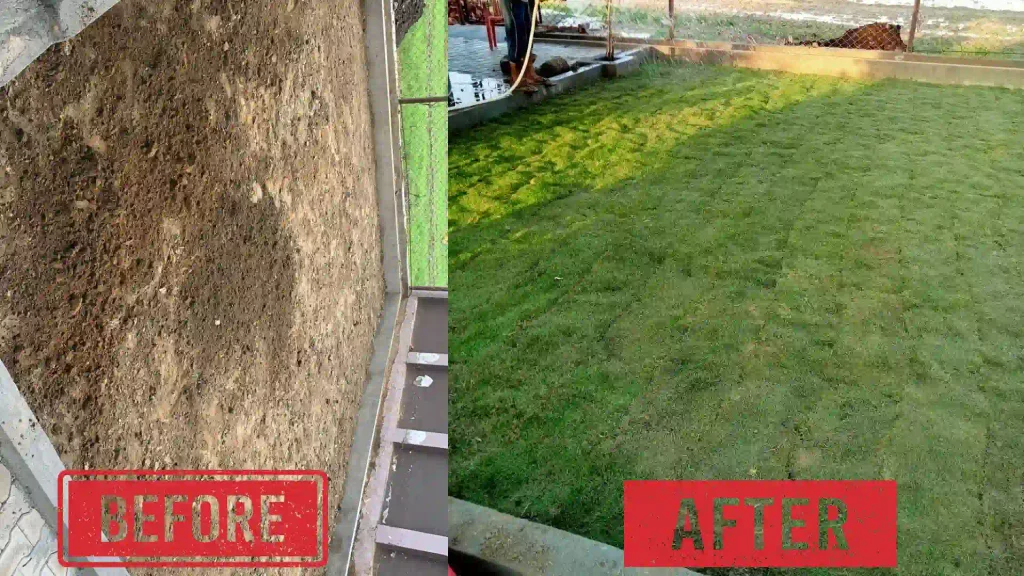
A flat looking lawn is not necessarily a well graded lawn. Grading is about directing water, not just making the surface smooth.
Slope away from buildings. The lawn surface should slope gently away from the house wall at a gradient of about 1 to 2% (1 to 2 cm drop per metre). This prevents rainwater from pooling against the foundation and causing damp problems.
No low spots. Walk the area after a rain or flood it with a hose. Mark every spot where water collects. Fill these with soil mix and re-level. Low spots become permanent puddles that kill grass and breed mosquitoes.
Smooth surface. After levelling, roll the soil with a garden roller or stamp it with flat boards. Then rake lightly. The final surface should be firm enough that your footprint sinks less than 1 cm. Too soft and the turf will settle unevenly after laying. Too hard and roots can’t penetrate.
Match final level to pathways and edges. The finished soil level should sit about 2 to 3 cm below the level of adjacent pathways, driveways and garden borders. When the turf is laid on top, it will sit flush with these edges. If you level the soil flush with the pathway, the turf will sit above it and the edges will dry out and die.
What amendments should you mix in before laying grass?
Once the soil problems are fixed, the drainage is sorted and the grading is done, add a final nutrient layer before the turf goes down.
Base amendment (mandatory): Mix 4 to 5 kg of vermicompost or FYM per sq metre into the top 10 cm. This gives the new roots a nutrient rich bed to grow into immediately. Fresh turf that’s laid on amended soil establishes 30 to 40% faster than turf laid on plain soil.
Phosphorus boost (recommended): Add single super phosphate (SSP) at 50 grams per sq metre mixed into the top 5 cm. Phosphorus drives root development. Strong roots in the first 4 weeks determine whether the turf survives its first summer. This is one case where a targeted chemical addition makes sense even on an otherwise organic soil.
Cocopeat for sandy soils (optional): If your soil is sandy and you’ve already added FYM, a thin layer of cocopeat (1 cm) mixed in adds extra water retention. Cocopeat holds 8 to 10 times its weight in water, which helps sandy soils stay moist between irrigations.
Neem cake (optional): Mix neem cake at 100 grams per sq metre into the top 5 cm. It acts as a natural pest deterrent against white grubs and termites that attack new grass roots. Especially useful in areas with known grub problems.
After adding amendments, water the area lightly and let it settle for 2 to 3 days before laying turf. This gives the organic matter time to start integrating with the soil and reveals any low spots that need final filling. For the complete turf laying process that follows soil treatment, the step by step lawn installation guide picks up right where this guide ends.
How much does professional soil treatment cost?
Costs depend on the condition of your existing soil and the area to be treated.
For soil that’s reasonably okay (loamy, no debris, minor compaction): Light rotavation, FYM/vermicompost amendment and levelling. Material cost is roughly Rs 20 to Rs 30 per sq ft including organic manure. Labour adds Rs 5 to Rs 10 per sq ft. Total: Rs 25 to Rs 40 per sq ft.
For problem soil (heavy clay, debris filled, poor drainage): Deep excavation, debris removal, sand addition, organic amendment and grading. Material cost rises to Rs 40 to Rs 60 per sq ft. Labour Rs 15 to Rs 25 per sq ft. Total: Rs 55 to Rs 85 per sq ft.
For complete soil replacement (worst case): Remove the top 15 to 20 cm of existing soil, bring in fresh garden soil mix, add organic amendments and grade. Total: Rs 80 to Rs 120 per sq ft depending on transport distance for the new soil.
Compare this to the cost of re-laying a failed lawn 2 years later. New turf, labour, watering, plus the wasted investment from the first attempt. Proper soil treatment upfront costs 20 to 30% of the total lawn project budget but prevents 80% of lawn failures.
The organic manure component (vermicompost at Rs 960 per 50 kg bag, FYM at Rs 960 per 50 kg bag, cow dung manure at Rs 30 per kg) is the same regardless of whether you DIY or hire a professional. The organic manure buying guide covers products and rates in detail.
Can you do soil treatment yourself or do you need a professional?
DIY works for small areas (under 1,000 sq ft) with minor soil issues. If your soil is reasonably loose, not full of debris and just needs organic amendment and levelling, you can handle it with a spade, rake and a few bags of vermicompost. The work is physical but straightforward.
Call a professional for large areas, heavy clay, debris filled plots or drainage problems. You’ll need a rotavator or JCB for deep compaction. Sand and soil delivery needs a truck. Grading over 2,000 sq ft is hard to get right by eye. A professional landscaper or lawn contractor does this routinely and gets the levels right the first time.
Balaji Nursery can supply all the organic manure and amendment materials for your soil treatment project. Whether you’re doing it yourself or your contractor needs bulk material, they deliver vermicompost, FYM and cow dung manure in quantities from 500 kg upward.
For selecting the right grass variety for your climate after soil treatment is done, this guide helps match grass to region.
Ready to give your lawn the right foundation?
Test your soil. Fix the problems. Grade properly. Amend with organic manure. Then lay the grass.
That sequence is the difference between a lawn that looks good for 10 years and one that looks good for 10 weeks.
Balaji Nursery supplies vermicompost and FYM at Rs 960 per 50 kg bag, and cow dung manure at Rs 30 per kg. Minimum order is 500 kg. They also supply natural lawn grass across India, so you can get your soil amendments and your turf from the same place.
Call 8766234417 or 9354173113. Share your site condition, soil test results (if you have them) and lawn area. Their team will recommend the right products and quantities to get your soil ready for grass that lasts.
Last Updated on 4 hours ago by Balaji Nursery Editorial Team

- Why does soil treatment before laying grass decide whether your lawn survives or fails? - August 27, 2026
- What makes vermicompost the best organic soil booster for lawns and gardens? - August 24, 2026
- American Grass India: Uses, Benefits and Care - August 24, 2026