 by Balaji Nursery Editorial Team
Which garden planter is right for your home, balcony or terrace?
You want to grow something. But the plant isn’t the first decision. The planter is.
The wrong pot cracks in summer heat. The wrong size chokes the roots. The wrong material for your balcony means waterlogged floors and angry neighbours. And the wrong style next to your sofa makes the whole room look off.
This guide walks you through every type of garden planter that Balaji Nursery stocks. From Rs 5 nursery pots for propagation to Rs 9,000+ rotomoulded premium planters for a farmhouse entrance. For each type, you’ll know what it’s built for, what size to pick and roughly what it costs.
What types of planters are available for Indian homes?
Balaji Nursery carries 8 categories. Each serves a different purpose.
Nursery planters for growing and propagation. Fancy and designer planters for indoor and outdoor decor. Window and balcony planters for railing and sill spaces. Hanging baskets for vertical greenery. Tall tower planters for corners and entrances. Rotomoulded premium planters for farmhouses, lobbies and commercial spaces. Self watering pots for low maintenance setups. And novelty pots for accents and gifts.
Let’s go through each one.
What are nursery planters and who needs them?
These are the basic, functional pots that every gardener needs in bulk. They come in black, terra and white. No design frills. Just solid, UV protected plastic that does the job.
Sizes range from 3 inch to 20 inch. Prices start at around Rs 5 per piece for a 3 inch pot and go up to roughly Rs 460 for a 20 inch heavy duty pot. They come in bulk packs of 15 to 25 pieces.
Best for: Starting seeds and cuttings. Growing nursery stock before transplanting. Kitchen herb gardens where looks don’t matter. Placing inside decorative cache pots (put the nursery pot inside a pretty planter so you can swap plants without disturbing roots).
Size guide: 3 to 4 inch for seedlings and succulents. 6 to 8 inch for herbs, small flowers and indoor plants. 10 to 12 inch for medium shrubs, brinjal and chilli plants. 14 to 20 inch for large plants, small trees and floor standing greenery.
What are fancy and designer planters?
These are the show pieces. The planters you put in the living room, on the porch, beside the main door. They come in multiple finishes: solid colours, marble texture, ceramic finish, brick pattern and more.
Balaji Nursery stocks several designer ranges. Fancy Green planters from 4 to 26 inch (roughly Rs 14 to Rs 1,500 per piece). Anvi Green planters from 10 to 20 inch (roughly Rs 46 to Rs 600). Plus Apple Pots, Helix Pots, Euro Pots, Bail Pots, Rock Pots, Crown Pots and more. Each range has a distinct texture and profile.
Colours include white, white marble, green marble, pink marble, blue marble, beach marble, yellow, red, blue and green. Many ranges offer 10 or more colour options so you can match your decor.
Best for: Living rooms, entrance lobbies, dining areas, patio tables, balcony corners. Any spot where the planter is visible and needs to look intentional.
Size guide: 6 to 8 inch for tabletop display (money plant, succulent, small fern). 10 to 12 inch for floor standing indoor plants (snake plant, peace lily, aglaonema). 14 to 20 inch for large statement plants (fiddle leaf fig, areca palm, rubber plant).
All designer planters are UV protected, weather proof and recyclable. They look like ceramic but weigh a fraction of it, which matters on balconies where weight is a concern.
Which planters work best for windows and balconies?
Rectangular window planters are designed for sills, ledges and railing tops. They’re longer than they are wide, so they fit narrow spaces without sticking out.
Standard window planters come in 14 to 31 inch lengths. Prices range from roughly Rs 80 to Rs 660 depending on size and finish. They’re available in fresh white, terra and coloured options.
For balcony railings specifically, hook pots and railing planters clip directly onto the railing bar without drilling or mounting. Single hook pots start at around Rs 30 for a 4 inch vertical hook pot. Double hook pots for wider railings run about Rs 130. Railing hook pot designs include Daisy, Twister, Blossom, Victor and Royal Square, each with a different look.
Best for: Balcony railings (hook pots). Kitchen windows (14 to 17 inch planters for herbs). Apartment corridor ledges. Terrace parapet walls.
What to grow: Trailing plants like money plant and string of pearls look best in railing hook pots. Herbs (tulsi, mint, coriander) suit window planters. Seasonal flowers (petunia, pansy, marigold) in balcony boxes create a European window garden effect.
How do hanging baskets add greenery without taking floor space?
If your balcony is small or your terrace is crowded, hanging baskets let you go vertical. They come with chains for ceiling hooks or wall brackets.
Balaji Nursery stocks multiple hanging basket designs: Jasmine, Blossom, Bell, Crystal, Ruby, Heera, Twister, Victor, Zenith, Tulip and Lotus. Sizes range from 7 to 12 inch. Prices start at roughly Rs 23 for a basic Karisma basket and go up to about Rs 116 for a premium Sloffy hanging basket.
Best for: Covered balconies and porches (protection from heavy rain). Living room corners hung from ceiling hooks. Pergolas and sit out areas. Apartment entrances where floor space is zero.
What to grow: Spider plant, Boston fern, pothos, string of hearts, petunia and begonia. Pick trailing or cascading plants that spill over the edge of the basket for the best visual effect.
Tip: Hanging baskets dry out faster than ground pots because air circulates around them from all sides. Water daily in summer. Add a layer of sphagnum moss or cocopeat at the bottom to hold moisture longer.
When should you use tall tower planters?
Tall planters are narrow at the base and tall in height. They create vertical impact without taking much floor area. Think of them as plant pedestals.
The Uttam Tall Planter range goes from 6 x 8.5 inch up to 10 x 14 inch. Amrold Tower Pots in the Grow Planter collection start at 11 inch (8 x 11 inch) and go up to 22 inch (12.5 x 22.5 inch). Prices for the Grow Planter tower range vary by size.
Best for: Flanking a main door (a matched pair creates a welcoming entrance). Filling narrow spaces between furniture. Corners of living rooms and lobbies. Beside staircases. Restaurant entrances and hotel lobbies.
What to grow: Dracaena, snake plant (tall variety), bamboo palm, areca palm. Choose upright plants that complement the vertical shape of the planter instead of bushy or trailing ones.
What makes rotomoulded planters the premium choice?
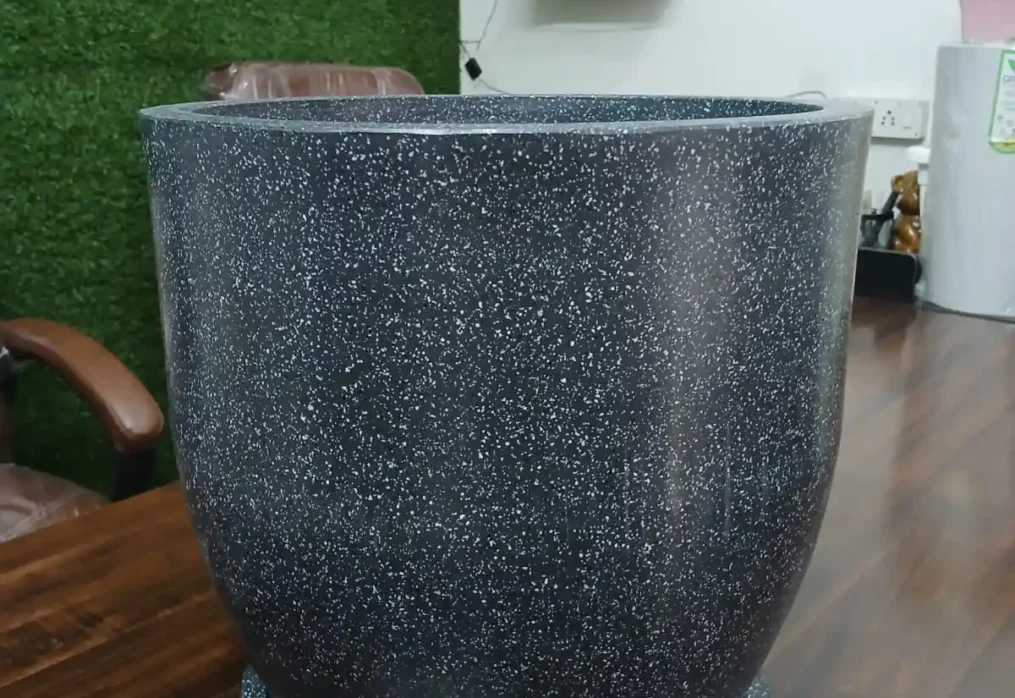
Rotomoulded (roto) planters are made by rotating molten plastic inside a mould. The result is a seamless, thick walled pot with no joints, no weak spots and a stone like finish that looks nothing like regular plastic.
Balaji Nursery stocks the full Roto collection: Roto Globe (9 to 25 inch, roughly Rs 670 to Rs 5,140), Roto Tower (10 to 20 inch, roughly Rs 1,540 to Rs 8,230), Roto Punch (12 to 36 inch, roughly Rs 930 to Rs 9,770), Roto Cube (10 to 18 inch, roughly Rs 820 to Rs 3,090), Roto Diamond, Roto Octa, Roto Orbit, Roto Largish, Roto Sphere, Roto Quad, Roto Rhombus, Roto Spark and more.
Available in three stone textured colours: light grey, sandstone brown and charcoal dark. These look like concrete or natural stone but weigh 60 to 70% less.
Best for: Farmhouse entrances and driveways. Corporate office lobbies. Hotel and restaurant patios. High end apartment terraces. Any space where cheap plastic would look out of place but real stone is too heavy and expensive.
Durability: Roto planters don’t crack in Indian summer heat, don’t fade in UV exposure and don’t chip like ceramic. They’re the most durable planter option available. Rates are excluding GST and bottom plates are available separately (Rs 60 to Rs 152 for 10 to 16 inch).
What about self watering pots and novelty designs?
Self watering pots have a built in water reservoir at the bottom. The plant draws water from the reservoir through capillary action. You fill the reservoir once every 5 to 7 days instead of watering daily. Balaji Nursery stocks transparent self watering pots (4 inch round and square) and Titan self watering pots (4 to 5.5 inch). Perfect for office desks, bedside tables and people who travel frequently.
Novelty pots are conversation starters. The range includes Buddha Pots (8 to 12 inch, roughly Rs 80 to Rs 196), Lion Pots (10 inch, Rs 172), Owl Pots (8 inch, Rs 104), Fish Pots, Tortoise Pots, Kanha Matki pots and Face Pots. These work as accent pieces on shelves, windowsills and coffee tables. Plant a small succulent or a trailing pothos in them.
There’s also an Iron Apple Pot with Stand (5 inch) that adds a vintage, hand painted look to a corner shelf or study table.
How do you pick the right size planter for your plant?
The rule is simple: the planter should be 2 inches wider in diameter than the plant’s current root ball.
A plant in a 6 inch nursery pot goes into an 8 inch display planter. A plant in a 10 inch pot moves to a 12 inch. Going too big (say, putting a 4 inch plant in a 14 inch pot) leaves too much wet soil around the roots, which causes root rot.
For depth: Most flowering plants and herbs need 6 to 8 inches of soil depth. Vegetables need 10 to 12 inches. Trees and large shrubs need 14 inches or more. Match the planter height to the plant’s root needs, not just the canopy size.
Always check for drainage holes. Every planter in Balaji Nursery’s range has drainage holes. If you’re using a decorative pot without holes as a cache pot (outer pot), place the nursery pot inside it and remove to drain after watering. Standing water in a sealed pot kills plants faster than underwatering.
For the right soil mix to fill your new planters, use vermicompost, garden soil and cocopeat in a 1:2:1 ratio. The vermicompost guide covers how to prepare the perfect potting mix.
What should you budget for a balcony garden setup?
Here are three budget levels for a typical Indian balcony (50 to 100 sq ft).
Starter setup (Rs 1,500 to Rs 3,000): 4 to 5 railing hook pots (Rs 30 to Rs 60 each), 2 to 3 window planters for herbs (Rs 80 to Rs 150 each), 1 hanging basket (Rs 50 to Rs 70). Grow money plant, tulsi, mint and a seasonal flower. Functional, green, minimal investment.
Mid range setup (Rs 5,000 to Rs 10,000): 6 to 8 designer pots in matching colours (Rs 100 to Rs 300 each), 3 to 4 railing hook pots, 2 hanging baskets, 1 tall planter for the corner. Add a mix of indoor plants, herbs and seasonal flowers. The balcony starts looking designed, not just planted.
Premium setup (Rs 15,000 to Rs 30,000): 2 to 3 Roto planters for statement corners (Rs 1,500 to Rs 3,000 each), 4 to 5 designer pots, matching hanging baskets, railing planters along the full railing length. Add a self watering pot on the coffee table. This looks like a magazine terrace garden.
These budgets cover planters only. Add Rs 500 to Rs 2,000 for potting soil and vermicompost depending on the number of pots. For seeds to grow in your new planters, the gardening seeds guide has the best picks by season.
Where do you buy quality garden planters in bulk?
Balaji Nursery stocks the full range: nursery pots, designer planters, window boxes, hanging baskets, railing hook pots, tall planters, rotomoulded premium pots, self watering pots and novelty designs. All types. All sizes from 2 inch to 36 inch.
Minimum order is 10 pieces. Delivery takes 1 to 2 weeks from order confirmation. Packing and forwarding charges are extra for nursery pots (Rs 300 per box).
All planters are UV protected, weather proof, lightweight and recyclable. The Grow Planter range is ISO 9001:2015 certified.
They also supply vermicompost (Rs 960 per 50 kg bag), gardening seeds (Rs 50 to Rs 1,200 per 100g packet) and garden tools, so you can set up your entire garden from one supplier.
Call 8766234417 or 9354173113 for a detailed price brochure with exact rates for every model and size. Tell them your space (balcony, terrace, farmhouse or commercial) and they’ll recommend the right mix of planters for your setup.
Last Updated on 2 weeks ago by Balaji Nursery Editorial Team

- Which lawn grass survives Bihar’s heat, monsoon and soil conditions? - October 16, 2026
- How do you pick the right planter size so your plant actually thrives? - October 10, 2026
- Tulsi Plant Direction as per Vastu: Where to Keep It at Home - October 3, 2026