 by Balaji Nursery Editorial Team
When is the right time to sow grass seeds in your part of India?
You can buy the best seed in the world. Prepare the soil perfectly. Water exactly right. And still get zero germination.
Because you sowed in the wrong month.
Grass seeds don’t care about your schedule. They care about soil temperature and moisture. Sow when the soil is too hot, too cold or too dry and the seeds sit there and die.
India has at least 6 distinct climate zones, each with different sowing windows. A February sowing that works perfectly in Delhi can fail in Bangalore. A September sowing that thrives in Chennai makes no sense in Shimla.
This guide gives you the exact sowing months for your region and your grass variety. If you haven’t picked a variety yet, the lawn grass seeds buying guide covers Bermuda, Selection No. 1 and Korean grass with prices and characteristics.
What soil temperature do grass seeds actually need?
Forget air temperature. What matters is the temperature of the soil at 5 cm depth, because that’s where your seeds sit.
Bermuda grass seeds: Need soil temperature between 20°C and 35°C for germination. Optimal is 25°C to 30°C. Below 18°C, germination slows to a crawl or stops entirely. Above 40°C, seeds cook before they can sprout.
Selection No. 1 seeds: Same range as Bermuda since it’s a Cynodon variety. 20°C to 35°C. Slightly more tolerant of the lower end than pure Bermuda, so it handles early spring sowing a bit better.
Korean grass (Zoysia) seeds: Germination range is 20°C to 30°C. Narrower and cooler than Bermuda. Korean grass does not germinate well in extreme heat. It prefers the mild windows, not the hot ones.
How to check soil temperature: Push a kitchen thermometer 5 cm into moist soil at 9 AM. Do this for 3 consecutive mornings. If the average is within the germination range, you’re in the window. If you don’t have a thermometer, use calendar timing by region (see below) as a reliable proxy.
What is the sowing calendar for north India?
Covers Delhi NCR, UP, Bihar, Rajasthan, Haryana, Punjab, MP.
January: Too cold. Soil temperature is 10°C to 15°C. No germination. Don’t sow.
February: Soil starts warming. Late February (after 15th) works for Bermuda and Selection No. 1 in the plains. Still too cold for hill areas. Korean grass: wait until March.
March: Best month for spring sowing. Soil is 22°C to 28°C. All three varieties germinate well. This is the primary sowing window for north India.
April: Still works for Bermuda and Selection No. 1. Getting too warm for Korean grass (soil crosses 30°C by late April in the plains). Sow early April at the latest.
May to June: Too hot. Soil surface hits 40°C to 50°C in direct sun. Seeds die. Do not sow. Exception: if you have drip irrigation and shade cloth, you can attempt Bermuda, but it’s risky and not recommended for beginners.
July: Monsoon arrives. Soil cools to 28°C to 32°C. But heavy rain washes seeds away before they germinate. Only sow if rain has been light and you can protect the area.
August to September: Second best window. Monsoon tapering off, soil still warm and moist. Late August through mid September is ideal for all three varieties. This is the post monsoon sowing window.
October: Works for Bermuda and Selection No. 1 in the first half. Soil is 24°C to 28°C. Korean grass: risky because the approaching winter doesn’t leave enough warm days for establishment.
November to December: Too cold. Growth stops by late November in north India. Seeds sown now sit dormant all winter and may rot before spring.
Best months: March (primary), late August to mid September (secondary).
What is the sowing calendar for south India?
Covers Tamil Nadu, Karnataka, Kerala, Andhra Pradesh, Telangana.
South India has a major advantage: warmer winters. Soil temperatures rarely drop below 18°C even in January. This gives you a much wider sowing window.
January to February: Works for Bermuda and Selection No. 1 in the plains. Soil is 20°C to 25°C. A winter sowing in south India gives the lawn time to establish before the April to May heat.
March: Excellent for all three varieties. Soil warms to 25°C to 30°C. Moisture from the retreating northeast monsoon (in Tamil Nadu) helps germination.
April to May: Hot but not as extreme as north India (35°C to 40°C vs 45°C+). Bermuda still germinates if you water 2 to 3 times daily. Korean grass: avoid. Coastal areas with sea breeze stay cooler and can sow Bermuda through May.
June to September (southwest monsoon): Heavy rain in Karnataka, Kerala and coastal AP. Too much water washes seeds. Wait for breaks between rain spells. Interior Karnataka and Telangana get less rain and can sow in July.
October to November: The northeast monsoon hits Tamil Nadu and coastal AP. But interior Karnataka, Telangana and parts of AP have mild, dry weather — perfect for sowing all three varieties.
December: Good sowing month for south India. Mild temperatures, reducing rain, adequate moisture in the soil. All three varieties work.
Best months: March (primary), October to November for interior areas, December to January for Tamil Nadu plains.
What about east India, the northeast and coastal areas?
East India (West Bengal, Odisha, Jharkhand):
Similar to north India but with heavier monsoon. Best windows: February to March (before monsoon) and September to October (after peak rain). Avoid June to August when Kolkata and coastal Odisha get 200 to 300 mm of rain per month.
Northeast India (Assam, Meghalaya, Tripura, Manipur):
Extended monsoon from May through September. Very narrow sowing windows. Best: March to early April and late October. The heavy rainfall means seed washout is a major risk. Consider raised beds or sod rolls instead of seeds in flood prone areas. The seed vs sod comparison helps you decide.
Coastal areas (Goa, Mumbai, Chennai coast, Kerala coast):
High humidity year round helps germination but also promotes fungal disease on young seedlings. Best: October to February when temperatures are mild and the heaviest monsoon rain has passed. Avoid the June to September monsoon months when waterlogging is almost guaranteed.
Hill stations (Shimla, Mussoorie, Ooty, Darjeeling, Shillong):
Cool climates with short warm seasons. Bermuda and Selection No. 1 need warmer soil than hills provide for much of the year. Best and often only window: April to May when soil finally crosses 20°C. Korean grass works better at altitude because it tolerates cooler conditions. Sow Korean grass from March to May.
What happens if you sow in the wrong month?
Different mistakes cause different failures.
Sowing in extreme heat (May to June in north India): Seeds dry out within hours of watering. Even 3 waterings a day can’t keep the top 5 mm moist when soil surface temperature is 45°C to 50°C. The seeds either cook or germinate and die within 48 hours because the seedling can’t survive the heat. Loss rate: 80 to 100%.
Sowing in peak monsoon (July to August in heavy rainfall zones): Seeds germinate but heavy downpours wash them into low spots, drains and corners. You end up with thick clumps in some areas and nothing in others. Loss rate: 30 to 60% depending on rainfall intensity.
Sowing in winter (December to January in north India): Seeds absorb moisture but the cold soil stalls germination. They sit underground for 6 to 8 weeks, during which time they can rot, be eaten by insects or develop fungal infections. If they survive till spring, germination is patchy and weak. Loss rate: 40 to 70%.
Sowing in the right month but wrong variety: Korean grass sown in April in Delhi germinates but the May heat stunts growth before the root system establishes. The seedlings turn brown by June. Bermuda sown in December in Shimla sits dormant all winter. Match the variety to the temperature window, not just the calendar.
The safest rule: when in doubt, wait. Missing a window by 2 weeks is better than sowing 2 weeks too early or too late. The next window is only a few months away.
Can you sow outside the ideal window with irrigation?
Sometimes, yes. But it takes effort and the results are less reliable.
Sowing in April in north India (marginal heat): Works for Bermuda if you water 3 times daily (early morning, noon misting, late afternoon). Use shade cloth over the seeded area to drop soil temperature by 5 to 8°C. Remove shade cloth after germination once seedlings are 3 cm tall. Success rate: about 60 to 70% with effort.
Sowing in October in north India (approaching cold): Bermuda and Selection No. 1 germinate fine in early October. The risk is that approaching winter stops growth before the lawn fills in. You get thin, patchy coverage that survives winter as a sparse lawn and fills in properly only the following spring. Workable but plan for a 6 to 8 month timeline instead of 3 months.
Sowing during monsoon breaks: If the forecast shows 7 to 10 dry days between rain spells, you can sow during that gap. The seeds germinate using soil moisture from the last rain. Once seedlings are 3 to 4 cm tall, they can survive moderate rain without washing away. Timing this requires watching weather forecasts daily.
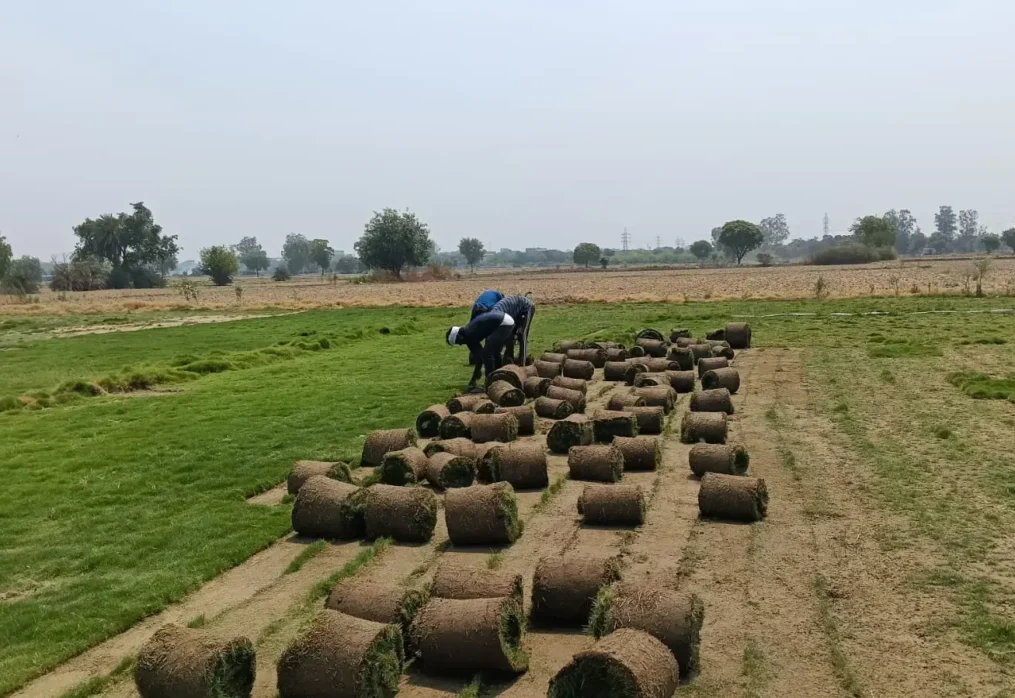
True off season sowing (dead winter or peak summer): Don’t. No amount of irrigation makes December sowing in Delhi or May sowing in Nagpur viable for home gardeners. If you absolutely must have a lawn immediately in the off season, use sod rolls instead. They establish in any month because the grass is already grown.
Does the sowing time change for overseeding vs new lawns?
Slightly. Overseeding has one advantage: the existing grass provides microclimate protection for the new seeds.
The established grass blades shade the soil surface, keeping it cooler in heat and warmer in mild cold. This extends the sowing window by about 2 to 3 weeks in either direction compared to bare soil sowing.
So if March is the primary window for new lawns in your area, overseeding can start in late February and extend through mid April. The existing turf protects the germinating seeds from temperature extremes.
For overseeding, mow the existing lawn short (2 to 3 cm) before sowing so the seeds reach the soil surface. Aerate first if the soil is compacted. Scatter seed at half the new lawn rate (3 to 5 grams per sq ft) and top dress with a thin layer of vermicompost.
For soil preparation details and organic manure mixing before any sowing, the soil treatment guide covers the full process.
Ready to sow at the right time?
Check your region. Check the month. Check your soil temperature if possible. Then sow with confidence.
Balaji Nursery supplies Bermuda seeds at Rs 10,000 per 500g pack, Selection No. 1 at Rs 5,000 per 500g pack and Korean grass at Rs 13,000 per 500g pack. If the sowing window doesn’t work for your timeline, they also supply natural turf rolls (Selection No. 1 at Rs 3 per sq ft, Bermuda at Rs 4 per sq ft, Korean grass at Rs 10 per sq ft) that establish in any month.
Call 8766234417 or 9354173113. Tell them your city and when you want your lawn ready. Their team will recommend whether to sow seeds now or wait for the next window, and which variety suits your region’s conditions best.
Last Updated on 3 weeks ago by Balaji Nursery Editorial Team

- How do you pick the right planter size so your plant actually thrives? - October 10, 2026
- Tulsi Plant Direction as per Vastu: Where to Keep It at Home - October 3, 2026
- Which garden planter is right for your home, balcony or terrace? - October 1, 2026