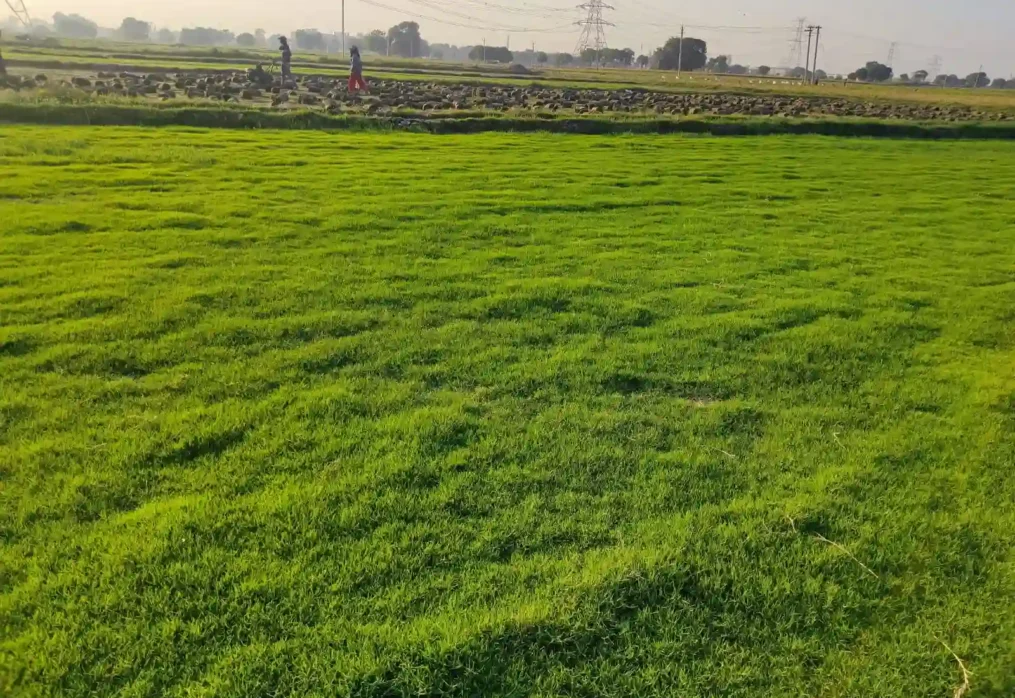
 by Balaji Nursery Editorial Team
Which lawn grass seeds should you buy for your Indian lawn?
Growing a lawn from seed is the most affordable way to get green coverage on a large area. No turf rolls. No heavy labour. Just seed, soil, water, and patience.
But the wrong seed for your climate, soil, or sunlight will waste your money and 2 to 3 months of waiting. You’ll stare at bare patches wondering why nothing came up.
This guide covers the three lawn grass seed varieties that Balaji Nursery stocks right now: Bermuda, Selection No. 1 and Korean grass. For each one, you’ll get exact pricing, coverage calculations, sowing method, and which conditions it suits best.
What are the current lawn grass seed prices?
Balaji Nursery sells seeds in 500g packs. Here are the 2026 rates.
Bermuda grass seeds: Rs 10,000 per 500g pack. Bermuda is the most popular warm season grass in India. It handles extreme heat, recovers from drought fast and creates a dense, wear resistant turf. This is the seed for sports grounds, public parks and home lawns that get heavy foot traffic.
Selection No. 1 seeds: Rs 5,000 per 500g pack. The most affordable option. Selection No. 1 is a hybrid Cynodon variety developed for Indian conditions. It grows fast, fills in quickly and tolerates a range of soil types. For homeowners who want a green lawn without spending on premium seed, this is the practical pick.
Korean grass (Zoysia) seeds: Rs 13,000 per 500g pack. The premium choice. Korean grass grows slowly but produces a fine textured, carpet like lawn that looks manicured with minimal effort. It tolerates shade better than Bermuda, making it ideal for gardens with trees or buildings that block sunlight for part of the day.
Minimum order is 500g (one pack). For larger projects, order multiple packs. Delivery is available across India.
How much seed do you need for your lawn area?
The seeding rate depends on the variety and whether you’re starting a new lawn or overseeding an existing one.
For a new lawn: Use 5 to 10 grams of seed per square foot. That’s roughly 50 to 100 grams per square metre. The higher rate gives denser coverage faster.
For overseeding (filling thin patches): Use 3 to 5 grams per square foot on the thin areas only.
Here’s what that means in practice for a new lawn.
500 sq ft lawn: 250 to 500g of seed. One pack is enough for Bermuda or Selection No. 1. Korean grass, being slower to establish, benefits from the higher seeding rate.
1,000 sq ft lawn: 500g to 1 kg. One to two packs depending on seeding density.
2,000 sq ft lawn: 1 to 2 kg. Two to four packs.
Cost comparison for a 1,000 sq ft lawn:
Selection No. 1 at 1 kg: Rs 10,000. Bermuda at 1 kg: Rs 20,000. Korean grass at 1 kg: Rs 26,000.
Compare that to natural turf rolls for the same area which can cost Rs 15,000 to Rs 40,000 depending on the grass type, plus Rs 5,000 to Rs 10,000 for laying labour. Seeds are cheaper upfront but take longer to establish.
Which seed variety suits which climate and region?

Bermuda grass seeds work best in hot, sunny regions. Delhi NCR, Rajasthan, Gujarat, Maharashtra, MP, UP, Bihar, and most of south India. Bermuda needs 6 to 8 hours of direct sunlight daily. It handles temperatures up to 45°C and bounces back from drought once established. If your lawn area gets full sun, Bermuda is the safest pick.
Selection No. 1 seeds suit the same regions as Bermuda but are more forgiving of less than perfect conditions. Slightly less sun? Selection No. 1 will manage. Average soil? It’ll grow. This variety was developed for Indian conditions specifically, so it handles the monsoon to summer swing that many imported varieties struggle with.
Korean grass (Zoysia) seeds are the choice for partial shade. Gardens with trees, courtyards with building shadows, north facing lawns. Korean grass tolerates 3 to 4 hours of direct sunlight. It also handles cooler hill station climates better than Bermuda. If your lawn gets mixed sun and shade, Korean grass gives the most even results.
Avoid cool season grasses like Kentucky Bluegrass or Ryegrass for permanent Indian lawns. They look great in winter but die in summer. These are useful only as temporary winter overseeding on an existing warm season lawn.
For a region by region breakdown of which grass works where, the Indian climate grass guide covers all major zones.
When should you sow lawn grass seeds in India?
Timing determines whether your seeds germinate in 7 days or rot in the ground.
Best window 1: February to March. Spring. Soil temperatures are rising. Weather is mild, not scorching. Seeds germinate in 7 to 14 days for Bermuda and Selection No. 1. Korean grass takes 14 to 21 days. The grass has March through May to establish before the monsoon arrives, which then fuels rapid growth.
Best window 2: August to September. Post monsoon. Soil is moist and warm. Humidity is high, which helps germination. Seeds go in after the heaviest rains have passed but while the soil stays naturally damp. The grass establishes through October and November before winter dormancy.
Avoid May to June. Peak summer heat kills seeds before they can germinate. Soil surface temperatures above 45°C cook the seed. Even with watering, the evaporation rate is too high to maintain the consistent moisture seeds need.
Avoid December to January (in north India). Cold soil slows germination to a crawl. Seeds may sit for 4 to 6 weeks without sprouting, during which time they’re vulnerable to rotting, washing away or being eaten by birds.
In south India (Tamil Nadu, Kerala, Karnataka), the October to November northeast monsoon window also works well for sowing.
How do you prepare soil before sowing seeds?
Seed grown lawns are more demanding about soil prep than turf lawns. Turf comes with its own root system and soil layer. Seeds have nothing. They need the soil beneath them to be exactly right.
Step 1: Clear the area. Remove all weeds, stones, debris and old grass. If weeds are heavy, apply a non selective herbicide 2 weeks before sowing and let everything die. Then rake out the dead material.
Step 2: Till the top 10 to 15 cm. Use a rotavator for large areas or a garden fork for small plots. The soil should be loose and crumbly, not hard or clumped. Break up any compaction.
Step 3: Mix in organic manure. Add 3 to 4 kg of vermicompost or FYM per square metre and work it into the tilled soil. This gives the germinating seeds a nutrient rich bed. The organic matter also helps the soil retain the consistent moisture that seeds need during their first 2 to 3 weeks.
Step 4: Level and firm the surface. Rake the soil smooth. Roll it lightly or tamp it with a flat board. The surface should be firm enough that seeds sit on top and make contact with the soil, but not so hard that water can’t penetrate. Seeds that sit on fluffy, loose soil often fail because they don’t make proper soil contact.
Step 5: Water the prepared bed. Give it a thorough soaking 24 hours before sowing. This settles the soil, reveals any low spots that need filling and ensures moisture is present when the seeds go in.
For a complete soil treatment process including fixing clay, sandy or problem soils, the soil treatment guide covers everything that should happen before seeds or turf.
What is the exact sowing method?
Even distribution is the single most important thing. Patchy sowing gives you a patchy lawn.
For small areas (under 500 sq ft): Divide your seed into two equal portions. Scatter the first half walking in one direction (say, north to south). Scatter the second half walking at a right angle (east to west). This cross pattern ensures even coverage.
For larger areas: Use a hand held broadcast spreader. Set it to the lightest setting and make multiple passes rather than one heavy pass. Again, walk in two perpendicular directions.
After sowing: Rake the surface very lightly (just a tickle, not deep raking) to work the seeds into the top 3 to 5 mm of soil. Seeds need soil contact to germinate. Seeds sitting exposed on top of the surface dry out and fail.
Then cover lightly. A thin layer of fine compost, cocopeat or sieved soil (2 to 3 mm thick) over the seeds helps retain moisture and protects from birds. Don’t bury them deep. Most grass seeds need some light to trigger germination.
Water gently. Use a fine mist sprayer or a watering can with a rose head. Heavy watering from a hose will wash seeds into clumps and leave bare spots. Keep the top 1 cm of soil consistently moist (not soaked) for the next 2 to 3 weeks.
What does germination and early growth look like?
Day 1 to 5: Nothing visible. The seeds are absorbing water and swelling. Don’t panic. Don’t add more seed. Just keep the soil moist.
Day 7 to 14 (Bermuda and Selection No. 1): Tiny green shoots appear. They look like thin needles poking out of the soil. You’ll see them better in morning light when dew droplets sit on the tips. Coverage will be spotty at first. That’s normal.
Day 14 to 21 (Korean grass): Korean grass germinates slower. If temperatures are warm and moisture is consistent, first shoots appear around week 2 to 3. Don’t give up on it too early.
Week 3 to 4: The shoots start tillering (sending out side branches). The lawn begins to look like a lawn instead of scattered blades. Keep watering. Keep off the grass. No foot traffic yet.
Week 5 to 6: Coverage thickens. When the grass reaches 7 to 8 cm tall, give it its first mow. Cut to 4 to 5 cm. Never remove more than one third of the blade length in a single cut. This first mow encourages the grass to spread sideways instead of growing only upward.
Month 3 to 4: The lawn is established. Gaps have filled in. You can start normal use. At this point, begin a regular organic feeding schedule. The organic manure guide covers what to apply and when.
What mistakes kill seed grown lawns?
Watering too hard. A strong jet of water from a hose washes seeds into corners, low spots and drain edges. You end up with thick clumps in some areas and bare patches in others. Always use a fine mist or gentle spray.
Letting the soil dry out. Seeds that start germinating and then dry out are dead. There’s no recovery. The top 1 cm of soil must stay consistently moist for the first 2 to 3 weeks. In hot weather, that means watering 2 to 3 times a day in light, short bursts.
Walking on new seedlings. Foot traffic on grass that’s less than 4 weeks old crushes the fragile shoots and compresses the soil. Keep everyone (including pets and kids) off the area until the first mow.
Mowing too early or too short. First mow should happen only when the grass is 7 to 8 cm tall. Cutting shorter than 4 cm on a young lawn stresses the plants before their root system is established. The grass turns brown and thins out.
Skipping soil preparation. Throwing seed on unprepared, compacted ground is the number one reason seed lawns fail. The seeds germinate but the roots can’t push into hard soil. The seedlings die within weeks. Proper soil prep takes a day but saves months of frustration. The soil treatment guide explains exactly what to do.
Buying cheap, unbranded seed. Low quality seed has poor germination rates (sometimes under 30%), weed seed contamination and no variety consistency. You plant what you think is Bermuda and get a mix of random grasses and weeds. Buy from a trusted supplier with tested seed batches.
Seeds or turf: how do you decide?
Choose seeds when: Budget is the priority. You have time to wait 3 to 4 months for full coverage. The area is large and turf laying costs would be high. You want a specific variety that’s hard to find in turf form. You’re comfortable with the daily watering commitment for the first month.
Choose turf when: You need an instant lawn. The area will be used soon (event, property handover, commercial opening). The site has slopes where seeds would wash away before germinating. You want guaranteed, even coverage from day one.
Balaji Nursery supplies both. Natural turf rolls for instant installation and seeds for grow from scratch projects. If you’re leaning toward turf, the step by step lawn installation guide covers the full process.
Where do you buy quality lawn grass seeds?
Balaji Nursery supplies three tested varieties in 500g packs.
Bermuda grass seeds at Rs 10,000 per 500g pack. Selection No. 1 seeds at Rs 5,000 per 500g pack. Korean grass (Zoysia) seeds at Rs 13,000 per 500g pack.
Minimum order is 500g (one pack). Every batch is tested for germination rate and purity. No weed seed contamination. No filler.
They also supply organic manure (vermicompost at Rs 960 per 50 kg bag, FYM at Rs 960 per 50 kg bag) for soil preparation before sowing. Getting your seeds and your soil amendments from the same place saves time and ensures compatibility.
Call 8766234417 or 9354173113. Tell them your lawn area, sunlight conditions and region. Their team will recommend the right variety, calculate the seed quantity you need and advise on the best sowing window for your location.
Last Updated on 2 weeks ago by Balaji Nursery Editorial Team

- How do you pick the right planter size so your plant actually thrives? - October 10, 2026
- Tulsi Plant Direction as per Vastu: Where to Keep It at Home - October 3, 2026
- Which garden planter is right for your home, balcony or terrace? - October 1, 2026