 by Balaji Nursery Editorial Team
What Type of Grass Works Best for Delhi’s Climate? Expert Guide Based on 25+ Years of Experience
What Type of Grass Works Best for Delhi’s Climate?
When homeowners search for the best lawn grass for Delhi, they often expect a simple answer. However, after more than 25 years of working with lawn grass and landscaping projects across Delhi NCR, we have learned that there is no single grass variety that works perfectly in every situation.
Delhi’s climate is one of the most challenging environments for lawn grass in India. The city experiences scorching summers with temperatures crossing 45°C, severe heat waves, cold winters, occasional frost, monsoon rainfall, high pollution levels, and varying soil conditions. Because of these extreme weather patterns, choosing the right grass requires careful consideration of sunlight, drainage, soil quality, water availability, and lawn usage.
Over the years, we have supplied and installed lawn grass for homes, farmhouses, builders, schools, parks, offices, institutions, and government properties across Delhi. Our work includes projects in Vasant Kunj, Vasant Vihar, Greater Kailash, Defence Colony, New Friends Colony, Sainik Farms, Civil Lines, Rohini, Hauz Khas, Golf Links, Golf Course Road areas, Janakpuri, Delhi Cantonment, Dwarka, Bijwasan, Panchsheel Park, Jor Bagh, Prithviraj Road, and many other premium locations throughout Delhi NCR.
Based on this practical experience, here is what homeowners should know before selecting lawn grass for Delhi’s climate.
Understanding Delhi’s Climate and Its Impact on Lawn Grass
Delhi experiences highly extreme weather conditions throughout the year.
During summer, intense heat waves and high temperatures place tremendous stress on grass roots and foliage. During winter, low temperatures and occasional frost can slow growth and reduce turf density. Monsoon rains bring welcome moisture but can also create drainage and waterlogging problems. Pollution, dust, and urban heat effects further increase stress on lawns.
Because of these conditions, lawn grass selection should never be based solely on appearance or price. Instead, it should be based on the specific environmental conditions of the property.
Key factors include:
- Daily sunlight exposure
- Soil quality and pH
- Drainage efficiency
- Water availability
- Expected foot traffic
- Maintenance budget
- Landscape design requirements
These factors determine whether a lawn will thrive for years or struggle within a few months.
 Which Grass Performs Best in Delhi?
 Which Grass Performs Best in Delhi?
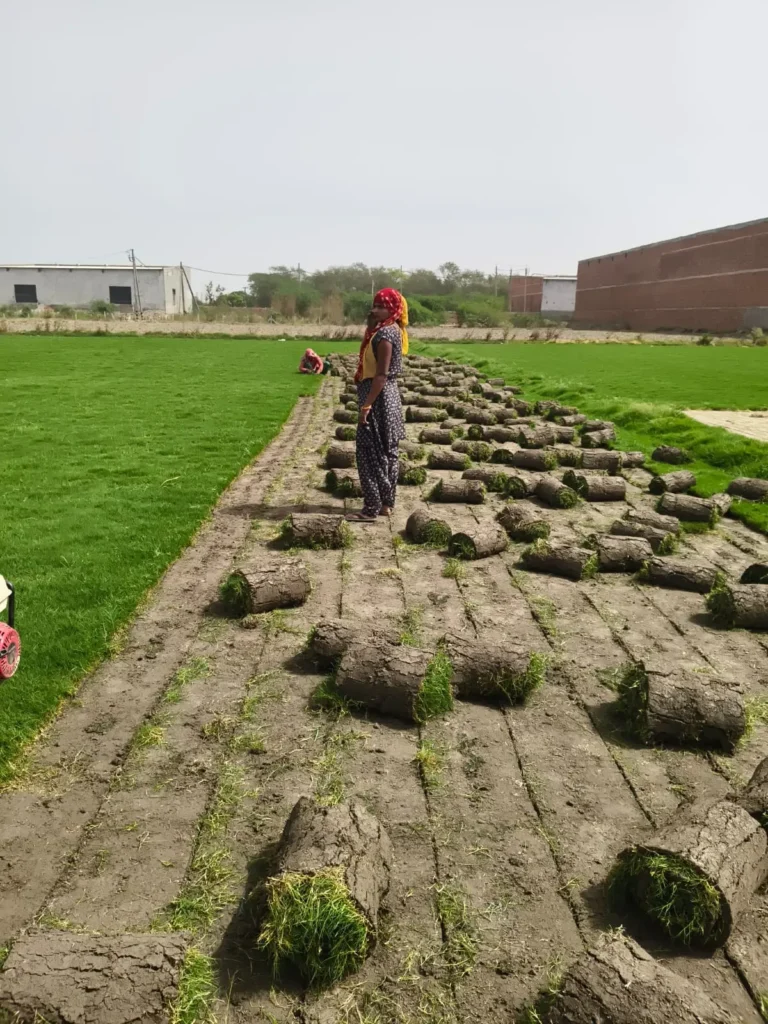
Based on our experience, Bermuda Grass (Doob Grass or Selection No. 1) performs successfully in approximately 80% of Delhi landscapes.
Why Bermuda Grass Is So Popular
Bermuda Grass remains one of the most reliable choices for Delhi because it offers:
- Excellent heat tolerance
- Strong drought resistance
- Rapid recovery from wear and tear
- Good performance under full sunlight
- High durability in active lawns
- Strong root development
- Cost-effective maintenance
For lawns receiving adequate sunlight and regular usage, Bermuda Grass consistently delivers strong results throughout the year.
Its ability to remain green during Delhi’s harsh summer months makes it particularly attractive for homeowners who want a durable and resilient lawn.
Other Grass Varieties Suitable for Delhi
Although Bermuda Grass works well in most situations, other varieties may be better suited depending on the site’s conditions.
Mexican Grass
Mexican Grass is widely used in residential lawns because of its:
- Soft texture
- Attractive appearance
- Relatively low maintenance
- Reduced mowing requirements
- Good visual appeal throughout much of the year
Korean Grass
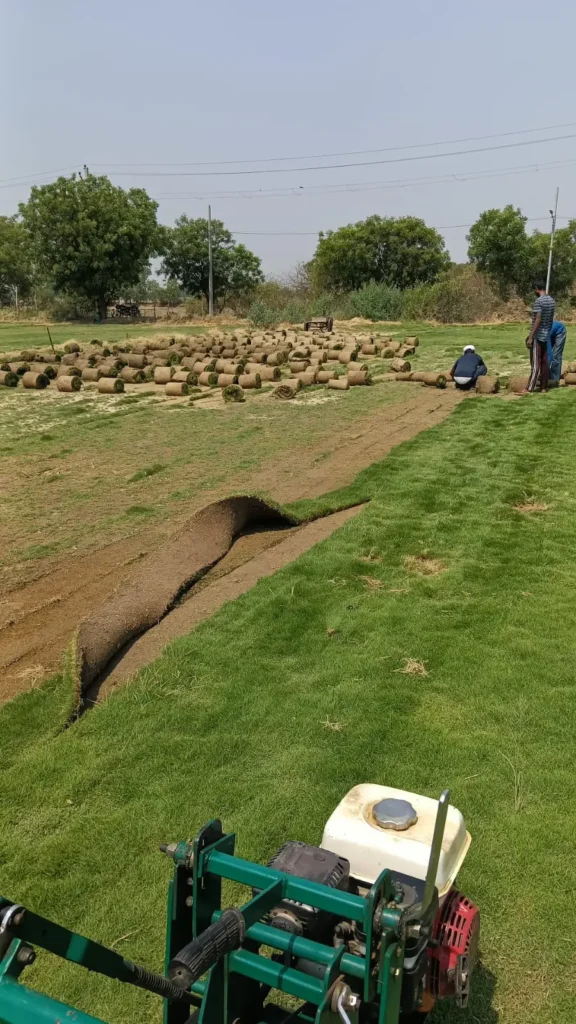
Korean Grass is often selected for premium landscapes where aesthetics are important.
Benefits include:
- Dense growth
- Fine texture
- Elegant appearance
- Lower mowing frequency
Zoysia Grass
Zoysia varieties are useful in locations where conditions may not be ideal for Bermuda Grass.
Advantages include:
- Dense turf formation
- Better adaptation to partial shade
- Slower growth
- Lower mowing requirements
Italian and American Grass Types
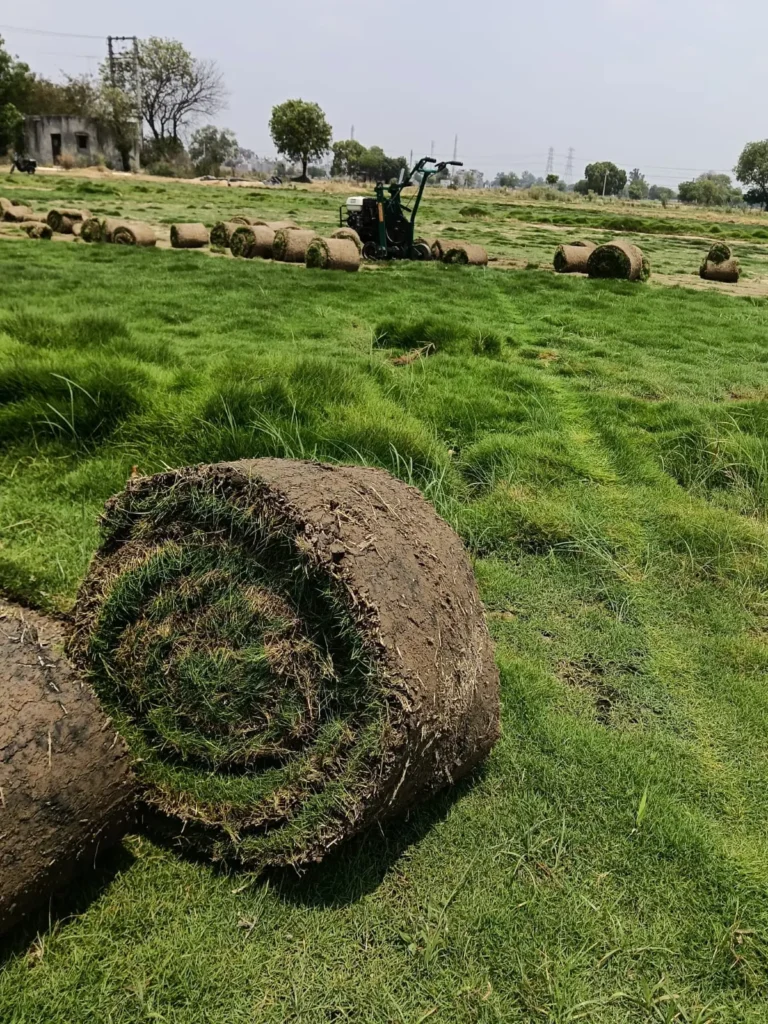
Certain Italian and American grass varieties are preferred in specialized landscapes because they often require:
- Less frequent watering
- Lower mowing frequency
- Moderate maintenance levels
- Attractive winter appearance
The best choice depends entirely on the site rather than personal preference alone.
Real Project Examples from Delhi NCR
One of the most valuable lessons we have learned over 25 years comes from observing how grass performs under different site conditions.
Example 1: Shaded Properties in Sainik Farms and Civil Lines
Many properties in Sainik Farms and Civil Lines contain mature trees, green belts, and extensive landscaping that create partial shade.
In these locations, homeowners who selected Mexican Grass, Korean Grass, Zoysia Grass, and similar varieties achieved significantly better long-term performance.
These lawns maintained stronger density and experienced fewer problems such as:
- Bare patches
- Thin turf
- Weak growth
- Disease-prone areas
Because the grass variety matched the site’s conditions, the lawns remained healthy for longer periods.
Example 2: Drainage Problems in Gurgaon and NCR
In several Gurgaon projects, the biggest issue was not the grass variety itself but poor drainage.
Many lawns suffered from:
- Waterlogging
- Compacted soil
- Root rot
- Patchy growth
- Poor turf establishment
Even premium grass varieties struggled when drainage was inadequate.
This experience reinforced an important lesson:
Proper drainage often matters more than the grass variety itself.
The Importance of Sunlight
One of the most overlooked factors in lawn success is sunlight.
Many homeowners believe that changing grass varieties will solve every problem. In reality, insufficient sunlight can weaken almost any lawn.
As a general guideline, lawns should receive at least 3–4 hours of direct sunlight daily.
Areas receiving less sunlight often experience:
- Reduced density
- Slow growth
- Weak rooting
- Increased disease pressure
- Bare patches
During summer, grass may survive because ambient temperatures remain warm. During winter, however, the lack of sunlight becomes much more noticeable and often causes grass decline.
This is one of the primary reasons homeowners observe lawn thinning during Delhi winters.
Common Mistakes Delhi Homeowners Make
1. Choosing Grass Based on Price
The most common mistake is selecting grass simply because it appears cheaper.
There is no universally “cheap” or “expensive” grass. The real question is whether the grass is suitable for the site’s conditions.
A low-cost grass installed in the wrong location often leads to higher maintenance and replacement costs later.
2. Ignoring Site Conditions
Many homeowners fail to evaluate:
- Sunlight exposure
- Soil conditions
- Shade levels
- Water availability
- Drainage quality
Ignoring these factors almost always leads to problems.
3. Improper Watering
Watering mistakes are extremely common.
Some homeowners overwater while others underwater.
Both practices can damage lawn health and increase disease risk.
4. Incorrect Mowing
Every grass variety has a recommended mowing height.
Cutting grass too short weakens the plant and reduces turf density.
Proper mowing practices are essential for long-term lawn performance.
5. Excessive Fertilizer Use
Many people believe that more fertilizer automatically means greener grass.
In reality, excessive fertilizer can:
- Burn turf
- Stress roots
- Increase maintenance requirements
- Create unhealthy growth patterns
6. Installing Sun-Loving Grass in Shade
This is one of the most expensive mistakes homeowners make.
Grass selected for full sunlight often struggles in shaded locations, leading to patchy and unattractive lawns.
How We Determine the Right Grass for a Property
Whenever a customer asks us which lawn grass is best, we follow a structured evaluation process.
Step 1: Evaluate the Site
We examine:
- Whether the lawn is indoors or outdoors
- Nearby buildings and trees
- Sunlight patterns
- Landscape design
Step 2: Test the Soil
Soil testing is extremely important.
We evaluate soil pH and determine whether corrective amendments are required.
Ideally, soil should remain within a suitable pH range, generally between 6 and 8.
If adjustments are needed, we improve the soil before installation.
Step 3: Assess Drainage
Drainage is carefully evaluated to prevent water accumulation around roots.
Step 4: Evaluate Foot Traffic
We determine how frequently the lawn will be used.
Different grass varieties perform differently under heavy foot traffic.
Step 5: Review Maintenance Expectations
We discuss:
- Available maintenance budget
- Irrigation systems
- Lawn care capabilities
- Long-term expectations
Step 6: Analyze Water Availability
Different grasses require different watering schedules.
Water availability influences the final recommendation.
Only after considering all these factors do we recommend the most appropriate grass variety.
Expert Recommendations for Different Situations
For Open Sunny Lawns
Recommended:
- Bermuda Grass
- Selection No. 1
For Farmhouses and Large Landscapes
Recommended:
- Bermuda Grass
- Zoysia Grass
For Decorative Residential Gardens
Recommended:
- Mexican Grass
- Korean Grass
For Areas with Partial Shade
Recommended:
- Zoysia Grass
- Korean Grass
- Mexican Grass (depending on light availability)
For High Foot Traffic Areas
Recommended:
- Bermuda Grass
- Selection No. 1
Final Verdict: What Type of Grass Works Best for Delhi’s Climate?
If we had to recommend one grass for the majority of Delhi properties, Bermuda Grass would be our first choice because of its exceptional heat tolerance, drought resistance, durability, and adaptability to Delhi’s extreme climate.
However, the best lawn grass is not necessarily the most popular variety.
The best grass is the one that matches the property’s sunlight conditions, drainage system, soil quality, maintenance capabilities, and usage requirements.
After more than 25 years of working on thousands of lawn projects across Delhi NCR, one conclusion remains consistent:
Successful lawns are built by choosing the right grass for the right location—not by choosing the cheapest or most fashionable variety.
Before installing any lawn, evaluate the site carefully, seek professional guidance, and select a grass variety that suits the conditions of your property. Doing so will save money, reduce maintenance, and create a healthier, greener lawn for years to come.
Last Updated on 4 months ago by Balaji Nursery Editorial Team

- How do you pick the right planter size so your plant actually thrives? - October 10, 2026
- Tulsi Plant Direction as per Vastu: Where to Keep It at Home - October 3, 2026
- Which garden planter is right for your home, balcony or terrace? - October 1, 2026