 by Balaji Nursery Editorial Team
How do you use organic manure to turn a dull lawn deep green?
You bought the vermicompost. The bags are sitting in your garden. Now what?
How much do you actually put? Where? When? Does the dose change for different grasses? What about clay soil versus sandy soil?
Most guides give you a single number and call it done. But your lawn isn’t generic. A Bermuda grass lawn on sandy soil in Rajasthan needs a different feeding approach than a Korean grass lawn on clay soil in Kolkata.
This guide gives you exact dosages by grass type, soil type and season. Plus a month by month calendar you can follow all year. If you haven’t chosen your manure yet, the organic manure buying guide covers what each type does and what it costs.
How much organic manure does each grass type need?
Different grasses have different appetites. Fast growers eat more. Slow growers need less but want better soil structure.
Bermuda grass (Doob) and Selection No. 1: Heavy feeders. These grasses grow fast and need consistent nitrogen to maintain thick coverage. Use 2 kg of vermicompost per sq metre per application. Feed 3 times a year (May, August and November). Between vermicompost applications, a cow dung manure top up of 0.5 kg per sq metre keeps the supply steady.
Korean grass (Zoysia japonica): Moderate feeder with slow lateral spread. Needs good soil structure more than heavy nutrition. Use 1.5 kg of vermicompost per sq metre, twice a year (June and October). Skip the cow dung top ups unless the grass looks pale. Over feeding Zoysia can cause thatch buildup.
Mexican grass (Stenotaphrum): Moderate to low feeder. Tolerates shade and lower fertility. Use 1 kg of vermicompost per sq metre, twice a year. Mexican grass responds better to FYM mixed into the soil during installation than to heavy top dressing later.
Kikuyu grass: Aggressive grower in warm climates. Needs feeding similar to Bermuda. Use 2 kg vermicompost per sq metre, 3 times a year. Kikuyu can handle cow dung manure at 1 kg per sq metre every 2 months without issue.
Cynodon hybrid lawns (419, Tifway): Premium sports turf varieties. Feed 1.5 to 2 kg vermicompost per sq metre, 3 times a year. These hybrids show nutrient deficiency faster than common Bermuda, so don’t skip the post monsoon application.
Not sure which grass you have? This guide on choosing the right grass for Indian climates can help you identify it.
How does soil type change the dosage?
The same grass on different soils needs different amounts of organic manure. Here’s why and what to adjust.
Clay soil (common in Delhi NCR, parts of UP, Bihar): Clay holds nutrients well but drains poorly and compacts hard. Your grass doesn’t need extra nutrients as much as it needs organic matter to loosen the soil. Increase FYM in the mix. Use a 60/40 blend of FYM and vermicompost instead of vermicompost alone. Apply 2 to 2.5 kg of the blend per sq metre. The bulky FYM opens up pore spaces in the clay over time.
Sandy soil (Rajasthan, coastal areas, parts of Gujarat): Sand drains fast and doesn’t hold nutrients. Anything you apply leaches away quickly with watering. Increase the frequency instead of the dose. Apply 1.5 kg vermicompost per sq metre but do it 4 times a year instead of 2. Add cow dung manure at 0.5 kg per sq metre between the main applications. The organic matter gradually improves the sand’s ability to hold water and nutrients.
Loamy soil (the ideal): Loam holds both water and nutrients well. Standard doses work perfectly. Apply 1.5 kg vermicompost per sq metre, twice a year. No adjustments needed. If you’re lucky enough to have loamy soil, your lawn is easier to maintain than most.
Red and laterite soil (Karnataka, Kerala, parts of Tamil Nadu): Naturally acidic and low in organic matter. These soils need more frequent organic manure application. Use 2 kg vermicompost per sq metre, 3 times a year. Adding a thin layer of cow dung manure (0.3 kg per sq metre) every 6 weeks during the growing season helps keep the pH balanced.
Black cotton soil (Maharashtra, MP, parts of Karnataka): Extremely heavy, cracks when dry, swells when wet. The toughest soil for lawns. Use FYM heavily (3 kg per sq metre) during initial soil preparation. After that, 1.5 kg vermicompost twice a year with 1 kg FYM mixed in. The FYM adds the organic fibre that prevents the cracking cycle.
Knowing your soil type is the single most important step before deciding your manure dosage. A soil test from any agricultural lab costs Rs 200 to Rs 500 and tells you exactly what your soil is missing.
What does a month by month feeding calendar look like?
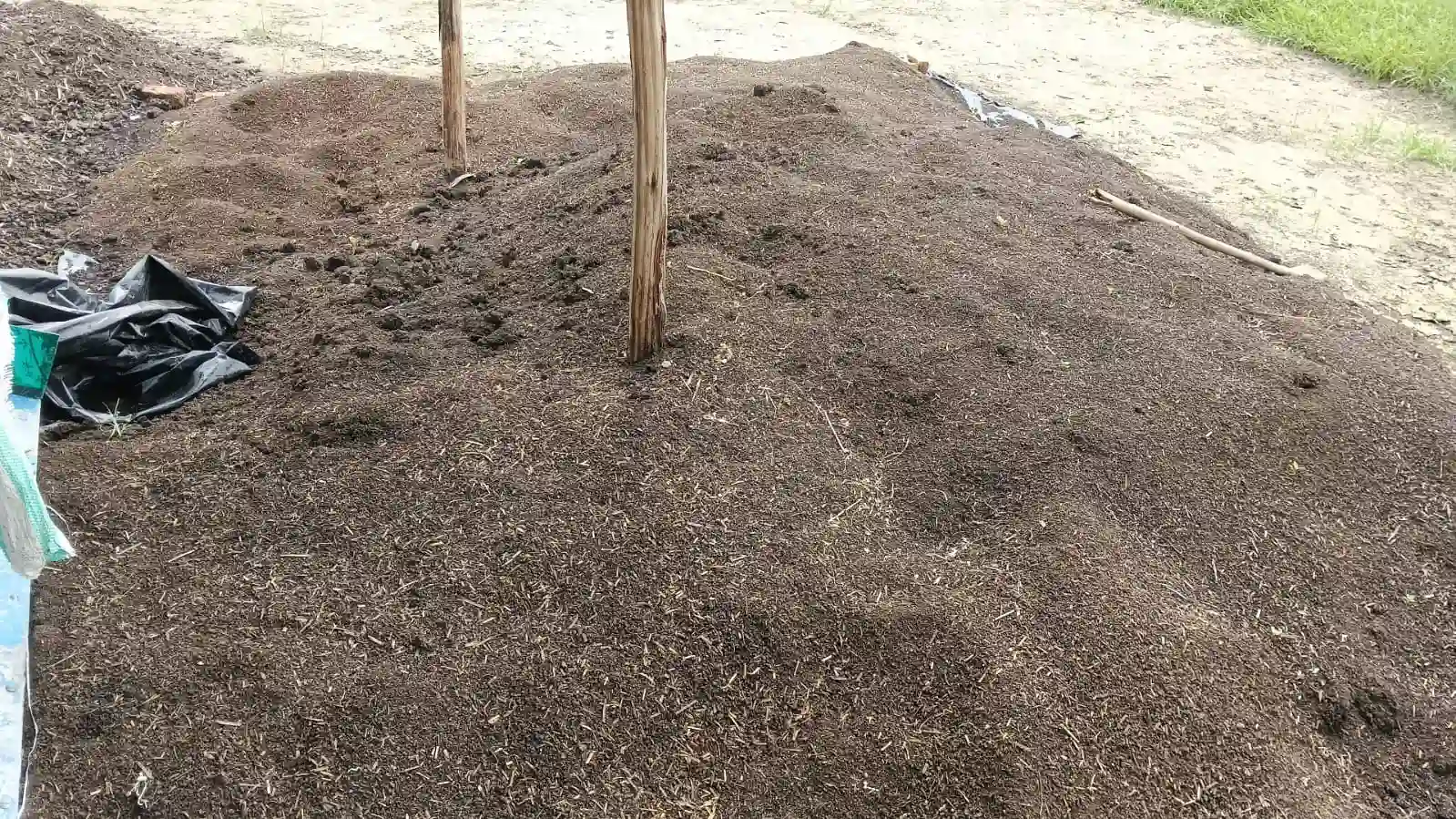
Here’s a year round schedule for a typical north and central India lawn. If you’re in south India with two monsoon windows, shift the August application to October.
January: Rest. The grass is semi dormant in the cold. No feeding needed. If you see mild yellowing, it’s normal winter colour loss, not deficiency.
February: Light top dressing of cow dung manure (0.3 to 0.5 kg per sq metre) as temperatures start rising. This gives the grass a head start before the spring growth flush. Water it in well.
March to April: The grass is waking up. Growth accelerates. If the lawn looks uneven or thin in patches, apply vermicompost to the weak areas only (spot feeding at 2 kg per sq metre on the patches). Save the full application for May.
May (most important application): Full vermicompost application across the entire lawn. 1.5 to 2 kg per sq metre depending on your grass type and soil. Aerate first if possible. This is the pre monsoon feed that fuels the biggest growth period of the year.
June to July: Monsoon is active. Don’t apply anything during heavy rain periods. The rain is washing nutrients into the root zone from the May application. Watch for waterlogging and ensure drainage.
August: Mid monsoon top up. Cow dung manure at 0.5 kg per sq metre. The heavy rain has leached some nutrients by now. This replenishes without overdoing it. Apply during a dry gap between rain spells.
September: If the lawn looks pale or thin after peak monsoon, a light vermicompost application (1 kg per sq metre) helps recovery. Skip this if the lawn looks healthy.
October to November (second key application): Full vermicompost feed. 1.5 to 2 kg per sq metre. This replenishes everything the monsoon washed away and builds reserves before winter. Aerate before applying for best results.
December: Optional cow dung manure top up (0.3 kg per sq metre) if you’re in a mild winter zone. Skip in areas with hard frost.
The two non negotiable feeds are May and October/November. Everything else is optional and depends on how your lawn responds. A healthy lawn on good soil might only need those two applications and nothing in between.
How do you read your lawn to know it needs feeding?
Your lawn tells you what it needs. You just have to look.
Pale green or yellow colour (uniform across the lawn): Nitrogen deficiency. The grass is hungry. Apply vermicompost immediately at 1.5 kg per sq metre. You’ll see improvement in 2 to 3 weeks.
Yellow tips with green base: Usually iron deficiency, common in alkaline soils. Organic manure helps indirectly by improving nutrient availability. Apply vermicompost and consider adding iron sulphate separately (2 grams per litre of water as a foliar spray).
Thin patches while the rest is thick: Local soil problem. The soil in those patches might be compacted, rocky or nutrient depleted. Don’t blanket feed the whole lawn. Aerate the thin patches, apply 2 to 3 kg vermicompost per sq metre directly on those spots and water well.
Grass grows slowly despite warm weather: Root zone compaction or lack of soil biology. The roots can’t access nutrients even if they’re present. Aerate the lawn, then apply FYM at 2 kg per sq metre. FYM’s bulk organic matter opens up compacted soil faster than vermicompost alone.
Grass goes brown after mowing (not in winter): Stress response. The grass doesn’t have enough reserves to recover after a cut. It’s been underfed for a while. Apply vermicompost, raise the mowing height by 1 cm and water deeply. The combination reduces stress and lets the grass rebuild.
Lots of weeds appearing: Weak grass leaves gaps that weeds colonise. The grass is losing the competition because the soil isn’t supporting it. Heavy organic manure application (2 kg vermicompost per sq metre plus FYM) combined with overseeding thickens the turf and crowds out weeds naturally.
For a complete guide on maintaining a healthy lawn including mowing, watering and pest control alongside organic feeding, this covers the full routine.
Can you overfeed a lawn with organic manure?
It’s very hard to damage grass with organic manure, but there are situations where too much works against you.
Thatch buildup. Excessive organic matter on the surface can create a layer of undecomposed material between the soil and the grass blades. This thatch layer blocks water and air from reaching the roots. Prevent this by raking the manure into the grass instead of leaving it sitting on top, and by aerating before application.
Nitrogen flush. Too much vermicompost at once can cause a sudden growth spurt. The grass grows tall and soft, making it more vulnerable to fungal infection and pest attack. Stick to the recommended doses (1.5 to 2 kg per sq metre maximum per application) and spread it evenly.
Drainage issues. On clay soil, dumping too much FYM on the surface without working it in can actually create a moisture trapping layer. Always mix FYM into the top soil through aeration holes or during renovation. Don’t just pile it on top.
The rule of thumb: if you can still see grass blades after applying, you haven’t overdone it. If the manure completely covers the grass, you’ve put too much in one spot. Spread it thinner or rake it out.
How do you calculate exactly how much manure to order?
Simple maths. Measure your lawn area in square metres (length x width). Multiply by the dose per sq metre. That’s your quantity per application. Multiply by the number of applications per year.
Example 1: 2,000 sq ft Bermuda lawn on clay soil in Delhi. 2,000 sq ft = roughly 186 sq metres. Dose: 2 kg vermicompost per sq metre (heavy feeder on clay). Per application: 372 kg. Three applications per year: 1,116 kg. That’s about 23 bags of vermicompost at Rs 960 per 50 kg bag = Rs 22,080 per year.
Example 2: 800 sq ft Korean grass lawn on loamy soil in Bangalore. 800 sq ft = roughly 74 sq metres. Dose: 1.5 kg per sq metre (moderate feeder, good soil). Per application: 111 kg. Two applications per year: 222 kg. That’s about 5 bags = Rs 4,800 per year.
Example 3: 5,000 sq ft farmhouse lawn, mixed grass, new installation. 5,000 sq ft = roughly 465 sq metres. Initial soil prep needs 4 kg FYM per sq metre: 1,860 kg of FYM. After that, maintenance at 1.5 kg vermicompost twice a year: 1,395 kg per year. Initial FYM order: 38 bags = Rs 36,480. Annual vermicompost: 28 bags = Rs 26,880.
Minimum order with Balaji Nursery is 500 kg. Even a small 500 sq ft lawn crosses this threshold for a year’s supply when you factor in 2 to 3 applications.
Ready to feed your lawn properly?
Know your grass type. Know your soil. Follow the calendar. That’s the entire strategy.
Balaji Nursery supplies vermicompost and FYM at Rs 960 per 50 kg bag, and cow dung manure at Rs 30 per kg. Minimum order is 500 kg. All products are 100% organic, fully processed and safe for direct application.
Call 8766234417 or 9354173113. Tell them your lawn size, grass type and soil condition. Their team will calculate the exact quantity and recommend a feeding schedule tailored to your lawn.
Last Updated on 2 months ago by Balaji Nursery Editorial Team

- How do you pick the right planter size so your plant actually thrives? - October 10, 2026
- Tulsi Plant Direction as per Vastu: Where to Keep It at Home - October 3, 2026
- Which garden planter is right for your home, balcony or terrace? - October 1, 2026