 by Balaji Nursery Editorial Team
Why are engineers using vetiver grass instead of concrete on highways and riverbanks?
You’ve seen retaining walls crack within 3 years. Gabion baskets rusting and bulging after two monsoons. Stone pitching washed out because the foundation underneath eroded anyway.
Hard structures fail on slopes because they fight water. Vetiver bioengineering works because it works with water. The roots anchor the soil. The leaves filter the runoff. And the whole system gets stronger every year instead of degrading.
This isn’t a guide about whether vetiver controls erosion. It does. That’s settled science backed by the World Bank, ICAR and over 100 countries. If you want the basics, the vetiver erosion control guide covers how and why.
This guide is about how to design vetiver bioengineering into real infrastructure projects. Highways. Riverbanks. Railway cuttings. Landslide prone hillsides. Dam spillways. The kind of projects that go into DPRs and government tenders.
What is vetiver bioengineering and how is it different from just planting grass?
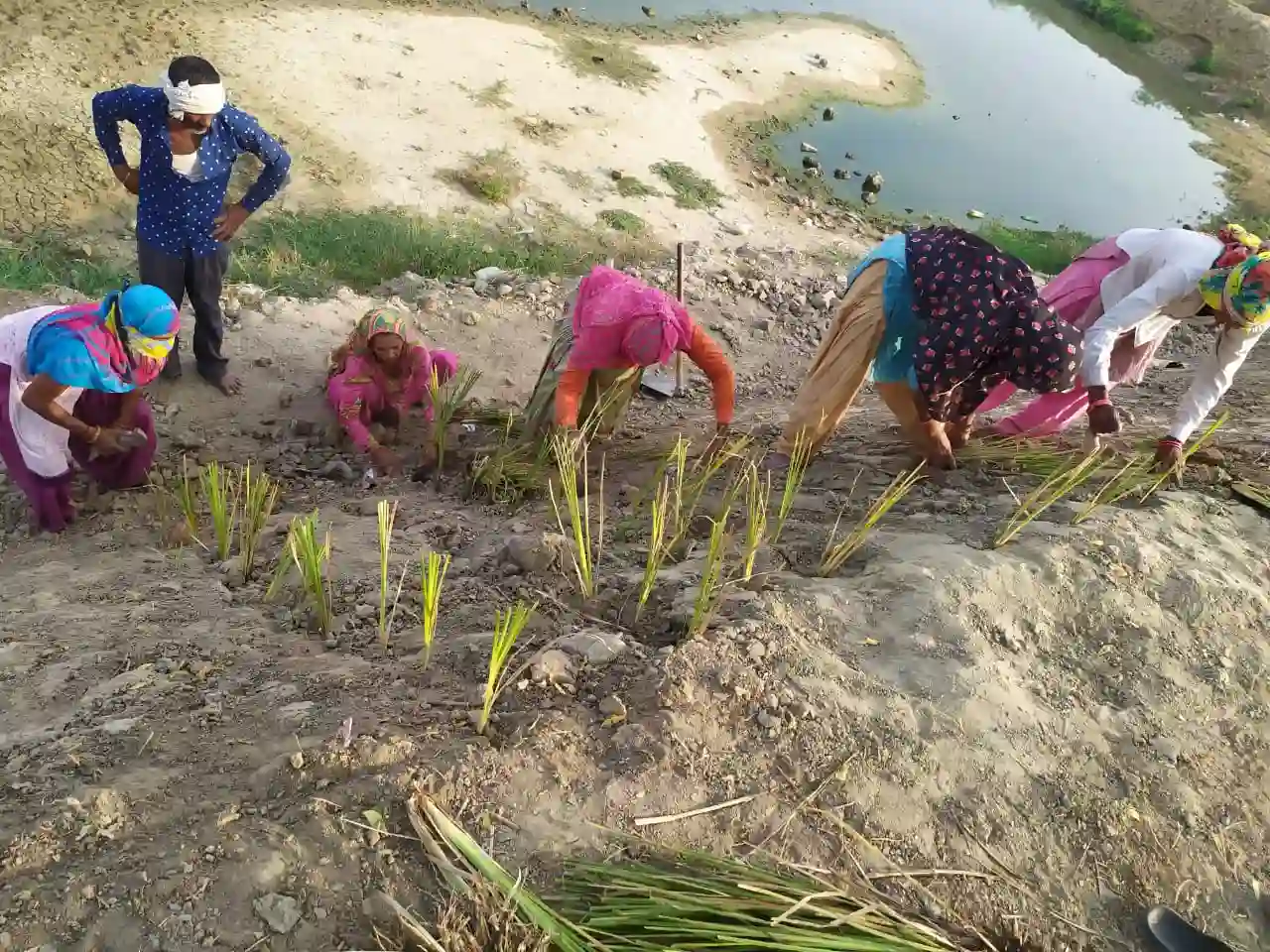
Bioengineering means using living plants as structural elements in engineering design. Not decoration. Not landscaping. Actual load bearing, soil stabilizing structural function.
When an engineer specifies vetiver in a slope design, the grass isn’t there to make it look green. It’s there to do the job of a retaining structure. The root mass at 3 to 4 metres depth acts like thousands of soil nails driven into the slope. The dense leaf canopy above ground acts like a sediment filter and velocity breaker for surface runoff.
The difference between bioengineering and casual planting is design intent. In bioengineering, you calculate the slope angle, the expected water load, the soil type and then specify the vetiver hedge spacing, row count and variety accordingly. It’s engineering with biology as the material.
Where does vetiver bioengineering apply in Indian infrastructure?
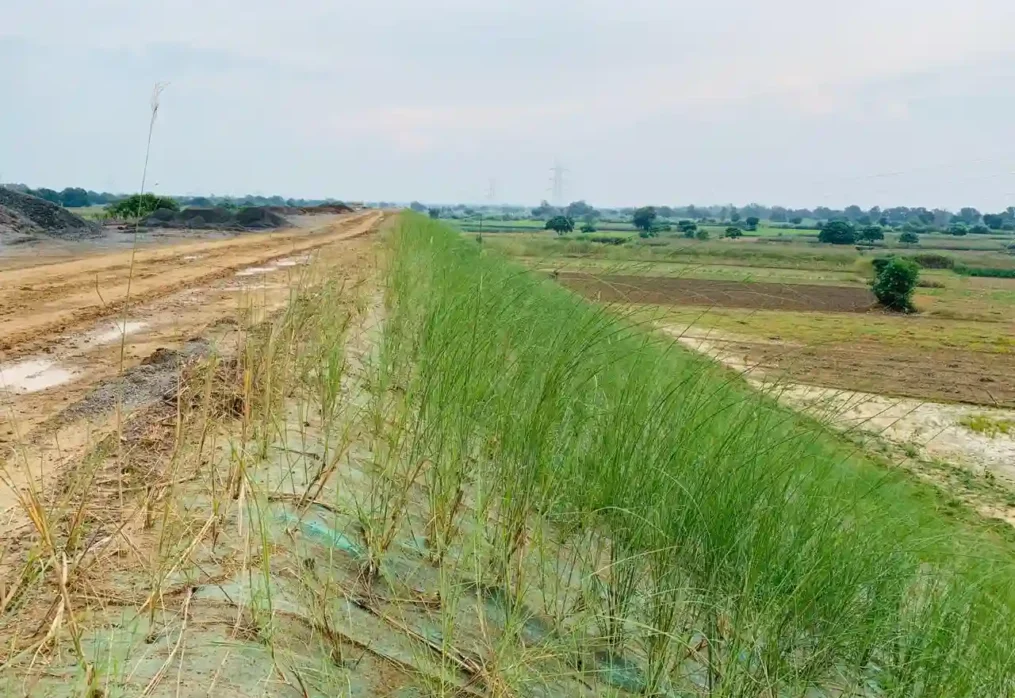
Highway embankments and road cuttings. Every national and state highway has exposed slopes where earth was cut or filled during construction. These slopes erode fast during monsoon, causing road edge failures and shoulder collapses. NHAI specifications now include bioengineering treatments for embankment slopes steeper than 1:2 (vertical to horizontal). Vetiver hedges along these slopes trap sediment, slow runoff and bind the fill material within one monsoon season.
Riverbanks and flood embankments. Rivers in Bihar, Assam, Bengal and UP eat into their banks every monsoon. Concrete toe walls and boulder revetments cost crores per kilometre and still fail when the foundation soil washes out from underneath. Vetiver planted along the bank edge and on the upper slope holds the soil that hard structures can’t reach. In flood embankments (bundhs), vetiver on the downstream slope prevents piping and seepage erosion that cause breaches.
Railway cuttings and track embankments. Indian Railways has thousands of kilometres of track on elevated embankments and through hill cuttings. Slope failures cause track misalignment and derailment risk. Vetiver hedges along railway embankments stabilize the ballast shoulder and prevent slope face erosion. The grass doesn’t interfere with track infrastructure because it grows in clumps, not runners.
Landslide prone hillsides. Uttarakhand, Himachal, the Northeast and the Western Ghats all face recurring landslides. Shallow landslides (the most common type, where the top 1 to 2 metres of soil slides) are exactly what vetiver roots are built to prevent. Roots penetrating 3 to 4 metres deep cross the failure plane and anchor the topsoil to the stable subsoil underneath.
Dam spillways and canal banks. Overflow from dam spillways scours the downstream area. Vetiver planted on spillway aprons and canal banks absorbs the energy of flowing water and holds the channel shape. Irrigation departments across India now include vetiver in canal maintenance budgets.
How do you design vetiver hedges for a specific slope?
The design depends on three things: slope gradient, soil type and expected water flow.
For gentle slopes (less than 15 degrees or roughly 1:4): Space vetiver hedge rows 1.5 metres apart vertically (measured down the slope face). Plant 8 to 10 slips per running metre within each row. Two to three rows are usually enough.
For moderate slopes (15 to 30 degrees or roughly 1:2): Reduce row spacing to 1 metre. Increase slip density to 10 per metre. Four to five rows minimum. This is the most common scenario on highway embankments and road cuttings.
For steep slopes (30 to 45 degrees or roughly 1:1): Row spacing drops to 50 to 75 cm. Slip density stays at 10 per metre. You’ll need 6 to 8 rows or more. On slopes this steep, combine vetiver with coir geotextile matting for the first monsoon season. The matting holds the soil while the roots establish.
For near vertical cuts (above 45 degrees): Vetiver alone won’t hold. You need a hybrid approach. Build a gabion or stone toe wall at the base, then plant vetiver on the slope above it. The hard structure handles the toe where forces are highest. Vetiver handles the rest.
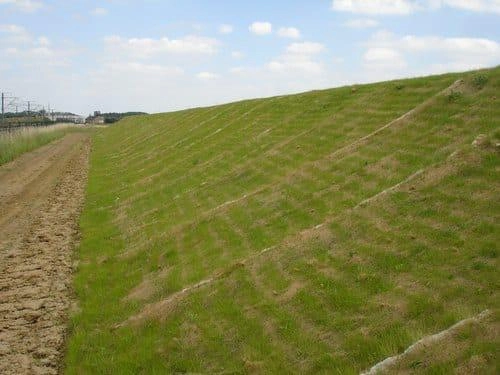
In all cases, every hedge row must follow the contour of the slope (horizontal line across the face). Never plant rows running up and down the slope.
How do you combine vetiver with hard engineering structures?
This is where vetiver bioengineering gets practical for real project sites. Most infrastructure slopes aren’t uniform. You might have a steep toe, a moderate middle section and a gentle upper slope. Using one solution for the entire face either overbuilds (expensive) or underbuilds (fails).
Gabion wall + vetiver: Build gabion baskets at the slope toe (the steepest, most stressed zone). Plant vetiver hedges on the slope face above the gabions. The gabions handle the mechanical load at the base. Vetiver stabilizes the rest. Cost drops by 40 to 60% compared to gabion walling the entire face.
Coir geotextile + vetiver: Lay coconut coir matting on the bare slope face. Plant vetiver slips through holes cut in the matting. The coir prevents surface erosion in the first 1 to 3 months while the vetiver roots establish. By the time the coir biodegrades (12 to 18 months), the vetiver has taken over completely. This combination is standard practice on freshly graded highway embankments.
Brush layering + vetiver: On large landslide scars, lay bundles of live branches (willow, bamboo) horizontally into the slope face. Plant vetiver between the brush layers. The branches provide immediate surface roughness and slope drainage. Vetiver provides the long term root anchoring. Common in Uttarakhand and Himachal restoration projects.
Check dams + vetiver: In gully erosion areas, build small stone check dams across the gully to slow water flow. Plant vetiver on both banks of the gully between the check dams. The dams handle the concentrated flow in the gully bed. Vetiver handles the banks. This approach is widely used in watershed development programs.
The principle is simple: use hard structures where forces are concentrated, use vetiver where forces are distributed across a surface. For installation on hilly terrain, the approach stays the same.
How do you size a vetiver order for a large infrastructure project?
The calculation is straightforward once you have the slope dimensions and design spacing.
Measure the slope length (horizontal distance along the road or river). Measure the slope height (vertical drop from top to bottom). Calculate the number of hedge rows based on your row spacing.
Example: a 1 km highway embankment, 6 metres high, slope angle 1:2 (moderate).
Slope face length (top to bottom along the surface): roughly 13 metres for a 1:2 slope at 6 metre height.
Row spacing: 1 metre apart. That gives 13 rows.
Each row is 1,000 metres long (the length of the embankment).
Slips per row at 10 per metre: 10,000 slips.
Total: 13 rows x 10,000 = 1,30,000 slips.
Add 10% buffer for replanting losses: roughly 1,43,000 slips.
At Rs 1 per slip (G22 or Simriddhi, the standard erosion control varieties), that’s Rs 1,43,000 for the planting material. For the full range of variety rates, the vetiver grass price guide has the breakdown.
Compare that to stone pitching the same 1 km embankment at Rs 500 to Rs 1,500 per running metre per row. The vetiver option is 10 to 15 times cheaper on material alone.
Which vetiver variety works best for infrastructure projects?
Monto (Rs 2 per slip) is the default for most institutional and government projects. It’s a sterile variety, meaning it won’t spread beyond the planted area. This matters on highways and railways where uncontrolled grass growth near infrastructure can create maintenance issues. Monto is also the most documented variety in World Bank funded bioengineering studies, so citing it in DPRs is easier.
G22 and Simriddhi (Rs 1 per slip each) are the cost effective workhorses. They root fast, grow uniformly and produce dense hedges. For projects where budget is tight and the area to cover is large (riverbanks, watershed treatments), these two are the practical choice. They aren’t sterile, but vetiver’s clumping growth habit means spreading is minimal anyway.
Dharini (Rs 3 per slip) is the premium option for high stakes sites. Severely degraded slopes, deep gully heads, riverbank curves where erosion pressure is extreme. Its root system goes deeper and faster than other varieties. The higher cost per slip is justified when failure isn’t an option.
Kesari (Rs 1.50 per slip) handles saline and alkaline conditions. Coastal embankments, tidal river stretches and arid zone projects where soil salinity is a problem. Other varieties may struggle in these soils. Kesari won’t.
For most highway and railway projects covering long stretches, G22 or Simriddhi at Rs 1 per slip offers the best balance of performance and cost. Reserve Monto or Dharini for critical sections.
How do you write vetiver into a project DPR or tender document?
Government tenders need specifications, not descriptions. Here’s what to include in the bioengineering section of your DPR.
Item description: “Supply, transport and planting of vetiver grass slips (Chrysopogon zizanioides) of [specify variety] variety for slope stabilization / riverbank protection / embankment treatment.”
Specification: “Slips shall be fresh (harvested within 72 hours of planting), minimum 2 tillers per slip, root length minimum 5 cm. Slips shall be trimmed to 15 to 20 cm leaf length before planting.”
Planting method: “Slips shall be planted in continuous hedgerows along the contour at [specify spacing] metre vertical intervals. Within each hedgerow, slips shall be spaced at 10 to 15 cm centre to centre. Planting shall be done during monsoon season (June to August) or with assured irrigation.”
Survival clause: “The contractor shall ensure minimum 90% survival rate of planted slips at 90 days after planting. Dead slips shall be replaced at the contractor’s cost within the next planting season.”
Measurement: “Payment shall be made per running metre of established hedgerow, or per slip planted and surviving at 90 days, as specified in the BOQ.”
These clauses are based on common formats used in NHAI, PMGSY and state PWD tenders. Adjust quantities and variety based on your specific project site. For the step by step planting method that contractors should follow on site, this guide has the details.
What does a vetiver bioengineering project cost per kilometre?
Costs vary by slope size and variety chosen. Here’s a realistic estimate for a typical highway embankment project.
Small embankment (3 metre height, gentle slope, 1 km length): About 40,000 to 60,000 slips at Rs 1 per slip = Rs 40,000 to Rs 60,000 for material. Add Rs 20,000 to Rs 30,000 for planting labour. Total: roughly Rs 60,000 to Rs 90,000 per km.
Medium embankment (6 metre height, moderate slope, 1 km): About 1,30,000 to 1,50,000 slips at Rs 1 per slip = Rs 1.3 to Rs 1.5 lakh for material. Labour Rs 40,000 to Rs 60,000. Total: roughly Rs 1.7 to Rs 2.1 lakh per km.
Large embankment or riverbank (10 metre height, steep slope, 1 km): About 3,00,000 to 4,00,000 slips. Using Monto at Rs 2 per slip for critical sections and G22 at Rs 1 for the rest brings the blended material cost to roughly Rs 4 to Rs 6 lakh. Labour Rs 80,000 to Rs 1.2 lakh. Total: roughly Rs 5 to Rs 7 lakh per km.
An equivalent concrete retaining wall for the same 1 km of large embankment would cost Rs 50 lakh to Rs 1 crore or more. Vetiver delivers 80 to 90% of the structural benefit at 5 to 10% of the cost.
And the maintenance budget? Practically zero. Vetiver maintains itself. Concrete needs inspection, repair and eventual replacement.
What institutional backing does vetiver bioengineering have?
This isn’t fringe science. Vetiver bioengineering has serious institutional weight behind it.
The World Bank has funded vetiver slope stabilization projects in over 100 countries since the 1990s. Their technical publications on the Vetiver System remain the global reference for bioengineering with this grass.
In India, ICAR (Indian Council of Agricultural Research) and CIMAP Lucknow have developed improved vetiver varieties specifically for Indian conditions. CIM Vetiver (Rs 0.90 per slip) is one result of this research.
NHAI includes bioengineering in its slope treatment guidelines. Multiple national highway projects across Uttarakhand, Himachal, Karnataka and the Northeast have used vetiver in their embankment designs.
State PWD departments, PMGSY (rural roads), watershed development boards and river management authorities all have existing line items or provisions for bioengineering works that include vetiver.
IIT Kanpur and several agricultural universities have published research on vetiver’s soil reinforcement properties, shear strength contribution and phytoremediation ability.
For public parks and government green projects, vetiver is now a standard specification alongside lawn grass and ornamental planting.
How do you get vetiver slips for a large infrastructure project?
Infrastructure projects need two things that most local nurseries can’t provide: volume and timing.
A single highway stretch can need 5 to 10 lakh slips. A river embankment project might need 20 to 50 lakh. And the slips have to arrive fresh within 1 to 3 days of harvesting, timed to the monsoon planting window.
Balaji Nursery has a production capacity of over 1,000 crore slips across all 9 vetiver varieties. That scale means even the largest highway or river project can be supplied in a single consignment.
They supply G22, Simriddhi, KS1, ODV 3, CIM Vetiver, Gulabi, Kesari, Monto and Dharini. Rates range from Rs 0.80 per slip (Gulabi) to Rs 3 per slip (Dharini). For infrastructure projects, G22 and Simriddhi at Rs 1 per slip are the most common order.
Delivery covers all of India within 1 to 3 days. Their team can advise on variety selection based on your site conditions, help calculate slip quantities for your BOQ and schedule deliveries to match your planting window.
Call 8766234417 or 9354173113. Share your project details and get a bulk quote. Whether it’s 1 lakh slips for a canal bank or 50 lakh for a national highway, they’ve handled it before.
Last Updated on 2 months ago by Balaji Nursery Editorial Team

- How do you pick the right planter size so your plant actually thrives? - October 10, 2026
- Tulsi Plant Direction as per Vastu: Where to Keep It at Home - October 3, 2026
- Which garden planter is right for your home, balcony or terrace? - October 1, 2026